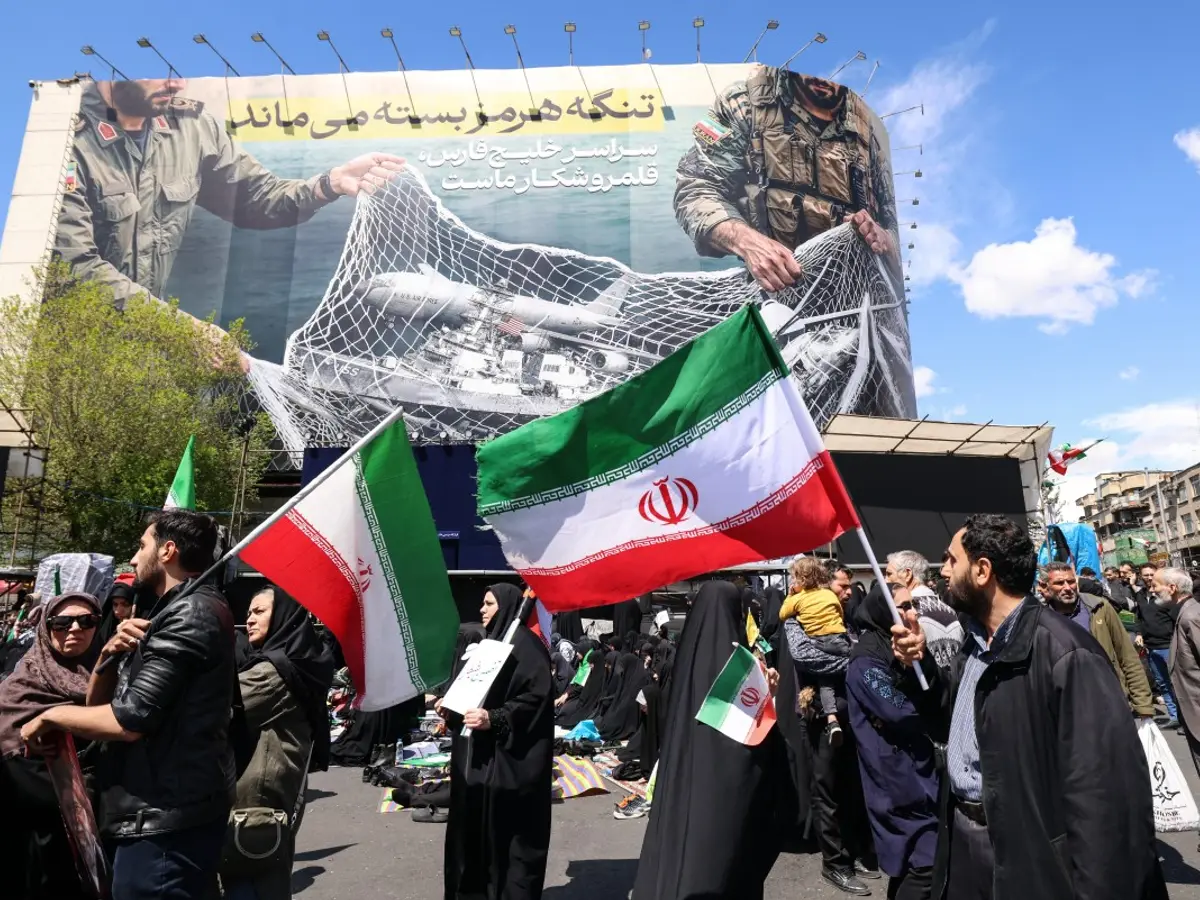
IRAN – Over the months since the signing of the so-called “Memorandum of Understanding,” the United States has pulled back from the high-tempo bombing campaign it previously conducted across wide areas of Iran. Earlier in the war, American bombing and rocket attacks from naval assets were concentrated mainly on the Iranian coast, with the aim of breaking Iran’s control of the Strait of Hormuz. The American naval and air presence in the region is now largely devoted to escort duty. Its main role is to guide cargo vessels through the Iranian blockade by keeping them close to the Omani coast and away from the Iranian-monitored passage to the north. This retreat into escort duty shows the limits of American military power in the Strait while exposing the fragility of the global oil market and the growing internationalization of conflict in the region.
While they are much more sheepish than before, fearing Iranian retaliation against the numerous and expensive air and naval assets deployed in the region, American strikes have still been occurring. These have focused primarily on Iranian oil cargo vessels, but they have also targeted an Iranian wedding and several civilian fishing craft, leaving dozens of Iranian civilians killed and wounded. The Pentagon has also had to admit to more war dead and wounded than ever before, revising its tally to 776 casualties, though skeptics and Iranian official media contend this is an undercount. Other reporting has documented civilian deaths and toxic exposure from the American war.
As for the efficacy of American strikes, Iranian control over Hormuz has only tightened, with more strikes on blockade runners and their American escorts than ever before, thanks to the recent deployment of anti-ship ballistic missiles against American carriers and destroyers in conjunction with a more aggressive posture. As of Monday, September 14, only four ships had been documented crossing the Strait, down from the already diminished 10 from the day previous.
After the U.S. failed to implement the “Memorandum of Understanding” agreement in any way and Ansar Allah’s campaign against Saudi Arabia gained new momentum, Iranian military and political leaders have been signaling a more proactive approach to the war. After much national discussion, the head of the Iranian National Security Council, Mohsen Rezaei, announced on September 6 a new “exclusion zone” outside of the Strait of Hormuz. While exact details on this zone are unclear, the intent, and what can be witnessed in the strike pattern, is a greater willingness to confront the American escorts directly rather than simply disabling the cargo vessels being escorted, along with a more generally aggressive approach to preventing cargo vessels from sneaking through.
This campaign has seen cargo vessels hit sea mines as well as come under drone and missile fire from the IRGC to prevent this blockade running. The volume of ships American forces have been able to smuggle through the Strait is only enough for them to justify continuing to try, but it has not been enough to alleviate the immense pressure on the oil market, nor to meaningfully challenge Iran’s supremacy over the Strait. Alongside these actions, Iran has been able to successfully export a significant amount of its oil, not to feed global market need, but rather to supply its strategic allies and collect much-needed hard currency.
Simultaneously, Ansar Allah has expanded its blockade on Saudi Arabia and carried out strikes on Saudi oil refineries. The closure of the East-West pipeline has added further pressure. China’s return to the oil market after a purchasing freeze, together with breakdowns at overextended American domestic refineries, has further tightened global oil supplies.
In the aftermath of the initial American strikes on Iran, global oil markets continued to behave as if the crisis could be contained, with futures mostly staying below $100 a barrel despite deepening supply pressures and bleak production prospects. Stability remained in the interest of the global capitalist class, which sought to prevent the full scale of the crisis from being priced into the international market. An open recognition of the disruption would have intensified market panic, especially while ruling class actors still hoped the crisis could be managed or resolved. That calculation is now breaking down. The pressure has become too great to conceal, and oil futures now sit at $110 at the time of writing, reflecting the growing force of the oil shock.
With American strikes on Iranian shipping resumed, Iranian retaliation is likely to become more severe. In addition to increasing the pace and volume of retaliatory strikes on American bases, Iran is deploying more advanced missiles in these attacks. On September 8, an Iranian missile strike on a U.S. base in Jordan used a cluster warhead, a missile payload designed to release multiple explosives across a wider area rather than detonate at a single point. Iran had used cluster warheads in strikes on “Israel,” but had not previously deployed them against an American base. The cluster warhead was part of a twenty missile salvo that damaged multiple helicopters and fighter jets parked in close proximity on the base.
Ansar Allah’s expanding campaign against Saudi Arabia for its continuous oppression of Yemen has further blurred the lines between conflicts. This has included direct strikes on oil facilities alongside ground maneuvers, while a joint Saudi-American-Zionist operations room has reportedly formed to combat Ansar Allah advances as Saudi Arabia calls on its allies for support. The intensification has also been reported in the context of renewed fighting for Sanaa and the Red Sea. The same blurring can be seen in Saudi Arabia’s delaying of a Gulf meeting with Oman and Iran over a new governance procedure for Hormuz, on the grounds that such talks would disrupt current power dynamics.
The internationalization of these conflicts reflects the sharpening contradictions of the global imperialist system. Regional wars, shipping blockades, oil shocks, weapons transfers, and military coalitions are not isolated crises. They are expressions of a world order in which monopoly capital struggles over markets, raw materials, energy routes, and spheres of influence, while forcing the costs of this struggle onto the oppressed nations and the working masses. As these contradictions deepen, the global class struggle sharpens with them. The same system that produces war in West Asia produces austerity, repression, debt, displacement, and intensified oppression and exploitation the world over.