The Masses Editorial Board received the following interview conducted by a member of Corriente Popular. The interview was held in Mexico City with the interviewees being two tenants who are members of an eviction defense committee that has occupied República de Cuba 11, a street in the center of Mexico city, for just over a year.
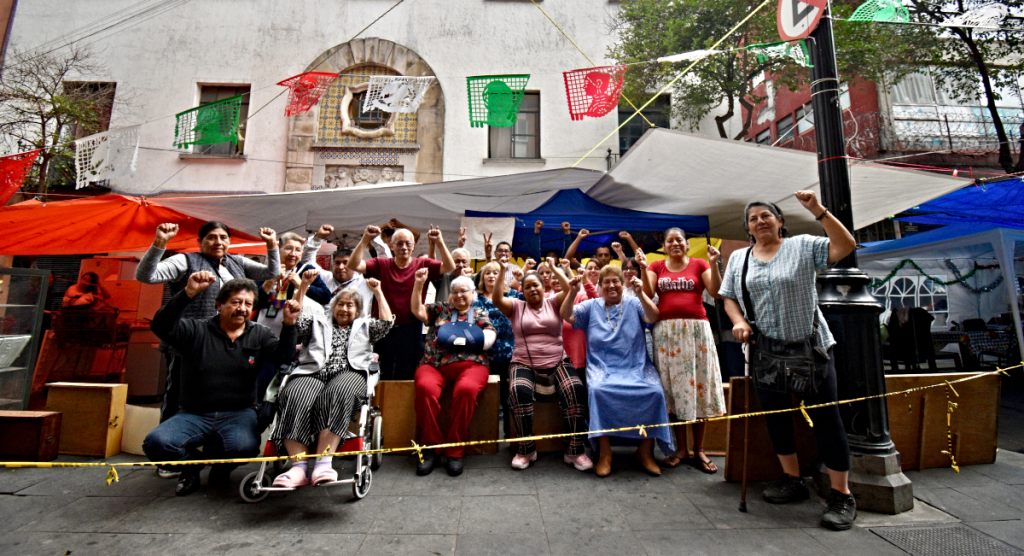
Recently on some travels through Mexico I had the opportunity to visit the República de Cuba 11 occupation, an extended eviction defense that has held down a street smack dab in the center of Mexico City for over a year, after 19 families and two businesses were forcibly displaced by a new landlord who obtained the property rights through some dubious juridical proceedings which involved obtaining the signature of a deceased former owner of the property.
I arrived to the occupation on the week of its anniversary, soon after it had been announced that the tenants had successfully forced the hand of the state in beginning a process of expropriation by which the courageous and hard-fighting tenants would be able to return to their homes. This effort was and is hard fought by the tenants, with much support from an organization called the Youth Front for Housing, which has provided an exemplary effort of what mass work can look like and accomplish.
On the day this interview was conducted, it was a balmy afternoon in Mexico City, the city center was replete with public art fresh from the recent teachers’ movement protests, and a nearby wall read: Marx, Engels, Lenin. After weaving among the occupation’s tarps, I came to a little stand where activists were selling gum, cigarettes, snacks. A friendly comrade let me inside and within the network of tents I saw groups of people playing cards, watching TV, cooking, and holding meetings. Two of the evicted tenants, María del Rocío Quevedo Juárez and Manuel Gómez Tello, were getting ready to have a dinner of rice and beans, and generously allowed me to sit with them and ask a few questions about their experiences in the housing struggle.
Thank you so much for allowing me to have a chat with the both of you! First things first, could you tell me when you first arrived to Republica de Cuba 11?
María: The 27th of August of 2025 we formed the occupation. And well, inside the building, since September of 1966, over seventy years.
Oh, wow. So you have a very long history with this building—seventy years is a long time! Could you tell me a bit about the eviction, how it was that it happened?
María:
They committed real estate fraud and obtained an eviction order without ever notifying us, that’s how they evicted us. The landlord died in 1992, yet they “brought him back to life” in 2017—taking him to Tizayuca—so he could sign the sale of the building. After 25 years, they resurrected him to sign the sale. They arrived at six in the morning, evicted 19 apartments, and took whatever they wanted. They used force, breaking locks and chains on the security gates. Most of us neighbors are elderly, we no longer work, we were asleep. They didn’t beat us, but they did intimidate us with shouting and threats.
Whose idea was it to construct this project? Whose idea was it to resist?
Maria:
It was everyone’s idea; they forced us out onto the street, hauled out our furniture, threw us out, and left us stranded there. We were out on the street—can you imagine?—scrambling to find storage space and trying to figure out what to do next. We went out and blocked the main avenue; we set fires and piled up mattresses and living room furniture. That’s what made the authorities show up and engage with us. By noon, we were all outside; they shut down the building, welded the main entrance and the shop shutters shut, and we all gathered out here to discuss our next move. We were all certain that the sale they’d pushed through was fraudulent. We all knew it wasn’t valid because the owner wasn’t there.
Did you put together the encampment that same day?
Maria:
Well to be honest it was little by little, we were left without tarps, without anything, in the midst of things, and, well, thank God it didn’t rain. [She laughs.]
At this point, Manuel had gotten his plate of rice and beans and joined in the conversation.
Gradually we delineated the spaces we’d occupy; we didn’t know we were going to stay here. We thought it was a good idea not to let anyone into the building.
María:
That’s right—that’s why we’re here; we’re holding our ground. If the bullies who evicted us get in, it’ll be hard to get them out. We have to stay here; we can’t let them in.
When did other collectives and groups begin to join in solidarity?
María:
The second day. The second day, right?
Manuel:
Almost immediately. They arrived, they asked: “What do you need?” They brought coffee, they made beans, broth–
María:
Bread, tortas, coffee, everything we needed, the Youth Front for Housing came by–
Manuel:
We were in shock, as if someone from our family had died. We didn’t know what was up, right? That same day we went and talked with the authorities here in the city center, they took us to chat, we returned to the occupation, set up some tables. We started doing daily shifts, we started cooking food—well, “we” is too many. They’ve never let me cook even some fried eggs-
María:
Not even lukewarm eggs!
She laughs.
Manuel:
Not even lukewarm eggs. So, then, the women that make really delicious stews here, they began stewing, feeding people. And we put ourselves together, we began having press conferences, bringing organizations.
María:
At that point the INVI—the national institute of housing—offered to shelter us in a hotel while this is sorted, the people who wanted that. It’s two blocks away. Most people accepted the offer.
So what happens at night, who stays in the space?
María:
The youth stay, our kids, the ones from the youth housing front.
Do you feel that you were already politicized? What was your political profile before being evicted?
Manuel:
Me, definitely! Since the student movement in ‘68 [when students in Mexico organized the National Strike Council, resulting in a CIA-coordinated massacre in Tlatelolco square in which hundreds were murdered]. I read about politics almost every day, about the left tendency worldwide.
María:
Blanca.
Manuel:
Ms. Blanca is also very politicized, very active. And of course, there are those of us here that aren’t, but we go on mobilizing ourselves, we share a hope of returning to our homes.
Was it difficult to convince others within the building to join the demand and the struggle, or was everyone decided from the get-go?
María:
No, we were all in total agreement about staying. Two neighbors left, but after a week, seeing we were still here fighting, they came back and they adapted to being here with us. Ms. Margarita quit after a while, because of her job, she couldn’t do it anymore. Another neighbor, Mr. Montoya, passed away, he died from the shock of seeing all his things hurled out onto the street. He had a [typewriter repair] workshop, they threw out his things, after so many years of work, and since they blocked off the windows, he couldn’t look inside the workshop to see if anything remained of his work. They took us out of the building on the 27th, he died the 29th, of a heart attack.
I’m very sorry, that’s tragic. Are you saying you think his death was caused by the eviction?
María:
Oh, absolutely, up until then he had seemed healthy, he was only 62. It was due to the eviction, the shock.
How do you think this struggle is interlinked with the larger housing struggle? Why do you think it’s been such an inspiration to others?
María:
Well we’ve begun this fight ourselves. But we want to to invite everyone to make themselves strong the way we have, and to fight for what’s theirs. We didn’t ask for handouts, but when no rent was being received anymore, which was after ‘97, we talked among ourselves and began to repair the building, to paint it together, fix it up, heal the building.
Manuel:
The movement manifested over the days, minute to minute. The occupation has been an important mediatic tool. They didn’t expect us to be here, they didn’t expect our street occupation. The defense is a referent now, it’s not that we wanted to become a model for something, but people come from all over to talk with us, to take our experience home with them, even internationally. This Thursday is the year anniversary, we’re going to celebrate, there’s going to be talks, and some taquitos. Without noticing, our resistance and our hope of returning home turned us into a prototype, into standard-bearers. Maybe due to being in the center of the city, due to arming a resistance, conducting ourselves somewhat well, and being politicized: all this has helped impulse us forward. It’s like a star, like a little angel, as if Diosito was looking on saying “let’s see what get up to now, those people from the occupation.”
History opens an eye and a question within itself: “What will the masses do?” it asks, “Will they see that it is my eye, the eye of history, that is watching anxiously within their gaze?”
The mass activists from the Youth Housing Front were lucid, eyes open and hands hot when they jumped into action, close to the struggle of the evicted tenants, without hesitation or faltering. This is the task of the mass activist, the example we must follow. Each living struggle of the masses, in all its successes and failures, is like Manuel’s star: shining above the winding path upon which proletarians and oppressed peoples march together in a zig-zag toward consciousness. The historical memory of the Tlatelolco massacre was lying in wait within that building, among the bustle of Mexico City, with the quiet, attentive tension of the guerrilla in the jungle. The memory was not resting, but holding an ear low to the ground, listening, until at last it unfurled a movement. In our work, when we look to each other, we must recognize the weight of sorrow: the sorrow of a neighbor murdered by eviction, of a craftsman sitting among the ruins of his craft; the sorrow of homelessness, of dispossession, a sorrow like a great, heavy stone hanging on the necks of the masses. As we enter into the depths of our mass work, of our struggle as masses that we are, we reach our hand up to grasp the stone and hurl it: to break open the window of history.