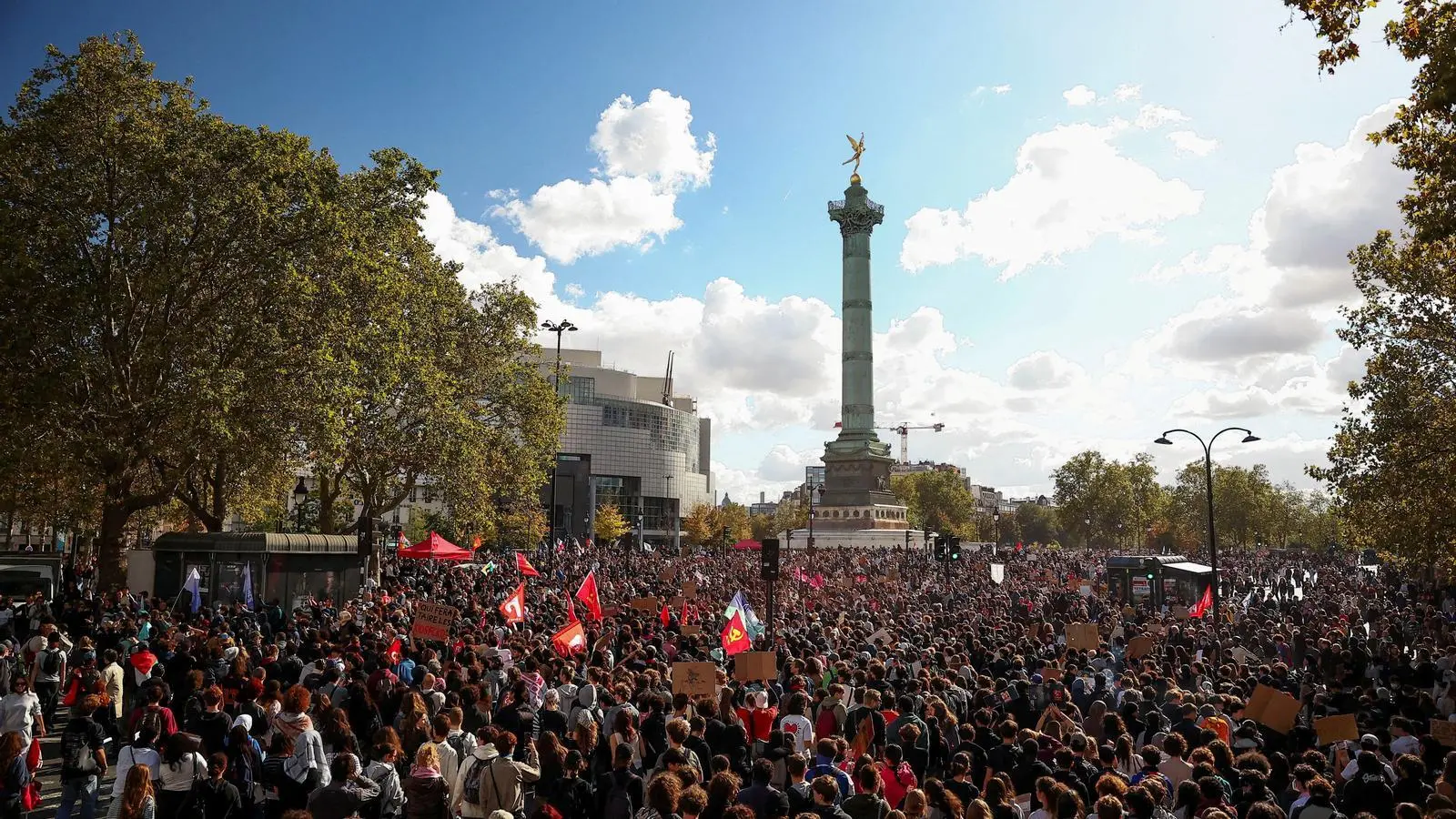
FRANCE – Since mid-September, students in France have launched an immense protest movement, joined on the front lines by family, workers, and other allied supporters in fighting back against riot police and other repressive forces of the French state. Students are denouncing overcrowded classrooms, teacher shortages, deteriorating school conditions, and inequality in education, recognizing the deterioration of the education system as a consequence of France redirecting school funding to the imperialist military budget.
The Union Syndicale Lycéenne, or the High School Students Union, said about 1,800 high schools,out of 3,700 in the country overall, had been blockaded by students or closed by the state as of October 6, and the Confédération Générale du Travail, General Confederation of Labor, estimated that 260,000 people had joined demonstrations by then. The day of action on October 17 multiplied the participation in the movement, with half a million people joining marches across the country.
While the imperialist French state has made small gestures towards the student movement, the main response to the protesters has been harsh repression, using mass arrests and prosecution of youth, tear gas, stun grenades, and batons. In the first week of protests, more than 5,000 people were arrested, with 87% of them being minors. One 15-year-old student lost his hand to a police grenade, a 14-year-old lost most of his teeth to a projectile fired at him from close range, and a 16-year-old suffered a severe eye injury. The government plans to pass a bill in the coming weeks to force financial liability upon protesters for all property damage. Through propaganda, the ruling class is attempting to isolate the students from support among the masses by portraying them as dangerous far-left agitators or criminals, while opportunists and reformists attempt to channel the masses justified anger towards their own electoral aims by claiming to be in solidarity with the youth.
The revolutionary student organization Jeunesse Communiste, or JC, has had a significant presence in the protests. In an interview with the Brazilian progressive newspaper A Nova Democracia, JC spoke about its view of the protest movement: it called for the protests to expand beyond the student sector, and to integrate the youth struggle with the broader mass struggle of the working class. Many unions and other workers have already mobilized in solidarity and unity with the youth struggle. JC noted the high unemployment rate among youth in France, higher than one fifth, as another source of mass discontentment alongside the deterioration in the education system.
Various reforms in education were instituted by the French State after the Yellow Vest protests in 2018, including the reform of the baccalauréat system, a standardized exam taken by graduating high school students, which cut expenses at the cost of increasing inequality among students; introducing the Parcoursup, a State-run college application program. The Parcoursup increased competition among students for university admission; while the Bienvenue en France, or the Welcome to France plan, drastically increased university fees for foreign students. Through these mechanisms, the bourgeois State was able to demobilize the student movement for several years by increasing competition between students, building anxiety, fear, and anger among them as a result. However, the underlying contradictions that students contend with remained, creating a “pressure cooker” of discontentment that has now exploded into mass resistance.
The underlying process behind the budget cuts to the education system is the debt crisis in France, as well as the bourgeois state’s push to expand its imperialist military. France’s debt has risen to 119% of its GDP, a similar ratio to that of the U.S., and investors have raised interest rates on French government borrowing to their highest level since 2002. This economic crisis is forcing France to decrease its reliance on borrowing funds, and turn to cutting spending and increasing taxes. Beyond reducing education costs, the Macron government has repeatedly turned to reducing the cost of the pension system, triggering workers strikes and mass protests in 2019 and 2023, and is again proposing to reduce pension spending in the proposed budget for 2027. While these social services are quickly sacrificed, the military budget was increased last year.
The student movement in France is only a single part of the rising global class-conscious movement in response to the deepening global imperialist crisis. In other European countries such as Spain, Portugal, Serbia, Belgium, Italy, Greece, Austria, and Albania, mass protests have also been launched in recent months. The decisive factor that will develop these movements from spontaneous uprisings into a revolutionary wave is firm proletarian leadership, with a strong revolutionary and class-conscious line for solving the misery inflicted on the masses. For all those who support the students in France, the best way to support their struggle long-term is to build political power for the masses here, in international solidarity.
[Image Source: France, October 8, thousands demonstrate at Place de la Bastille, Paris, Abdul Saboor]