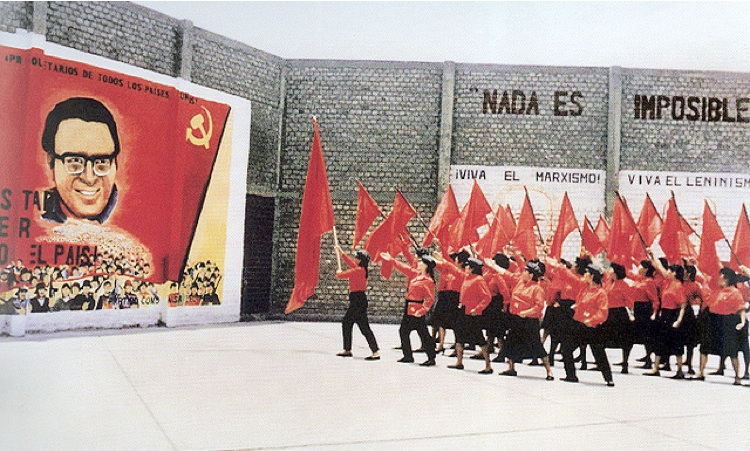
On June 18, 1986, in the midst of the People’s War in Peru, lifelong revolutionary, former member of José Carlos Mariátegui’s Socialist Party of Peru, and front-line journalist Angela Ramos bore witness to the start of a genocidal massacre in which 252 Peruvian revolutionaries and political prisoners were killed after demonstrating tremendous, unrelenting resistance. The victims never surrendered, and resisted until their last breaths, and June 19 is known now as “The Day of Heroism.” The day she witnessed the massacre, Angela Ramos wrote a poem, inscribing her witness forever into history. The Masses Editorial Board is proud to present a new English translation of the poem, one that attempts to preserve the spirit of the original, and highlight some of the subtle shifts between images that Ramos placed inside the poem. Some liberties have been taken with punctuation, but only to preserve the very important connective tissue between these images.
There is a dialectical movement from fear to courage, from surrender to struggle. We must always keep this movement close to our chest: the blood of the heart pumping like a current, like a red flag waving. The movement of the heart’s blood is how, in spite of inevitable repression, imprisonment, and temporary defeat, the struggle marches on. Opportunists and revisionists hide this fact, they invent excuses to escape the reality of what confrontation with capitalism really means. With her poetry, Angela Ramos fights against that forgetting, against the revision, the liquidation. The people’s martyrs have left us a legacy of courage to recover, a red flag to raise high, once again.
THE NIGHT OF ST. BARTHOLOMEW
Night of the black night,
soft lilac light of dawn
breaking the curfew.
The morning clears, now,
and the sky collapses
as a tragic flock,
the crows of vendetta
over the desolate isle.
The roar of shrapnelsong
sets the prisoners alert.
The hour of death has come!
Oh, augured death!
The stone flies, made sand,
the fish under the water flee.
The amphibian skiffs come
encircle the green waters—
Clasping palms,
the prisoners swear and cry:
“Meet death face-to-face,
no one fall to their knees!”
Bulging cavities,
foam bleeding in the mouth,
even the stone made man
in its very core whimpers.
Sloping over the rock,
heralds of vengeance,
raptors of death
spew black lava.
Human heads fly,
Oh, severed from their trunk,
the rocks pulverize,
bloodied over the sea,
blasted with dynamite,
scorched by flamethrowers;
they—like beasts—assail.
All die! None escape!
“Where are they?” mothers cry,
supplicants to the heavens,
“The crows have taken them,”
reply the jackals.
And in the blue pavilion—
slice of lonely earth—
the remains of the poets’ dreams:
they who dreamed of revolution,
who will, with hymns, return
with unfurling standards,
with new dreams, new hungers
of those who, in dying, march on.