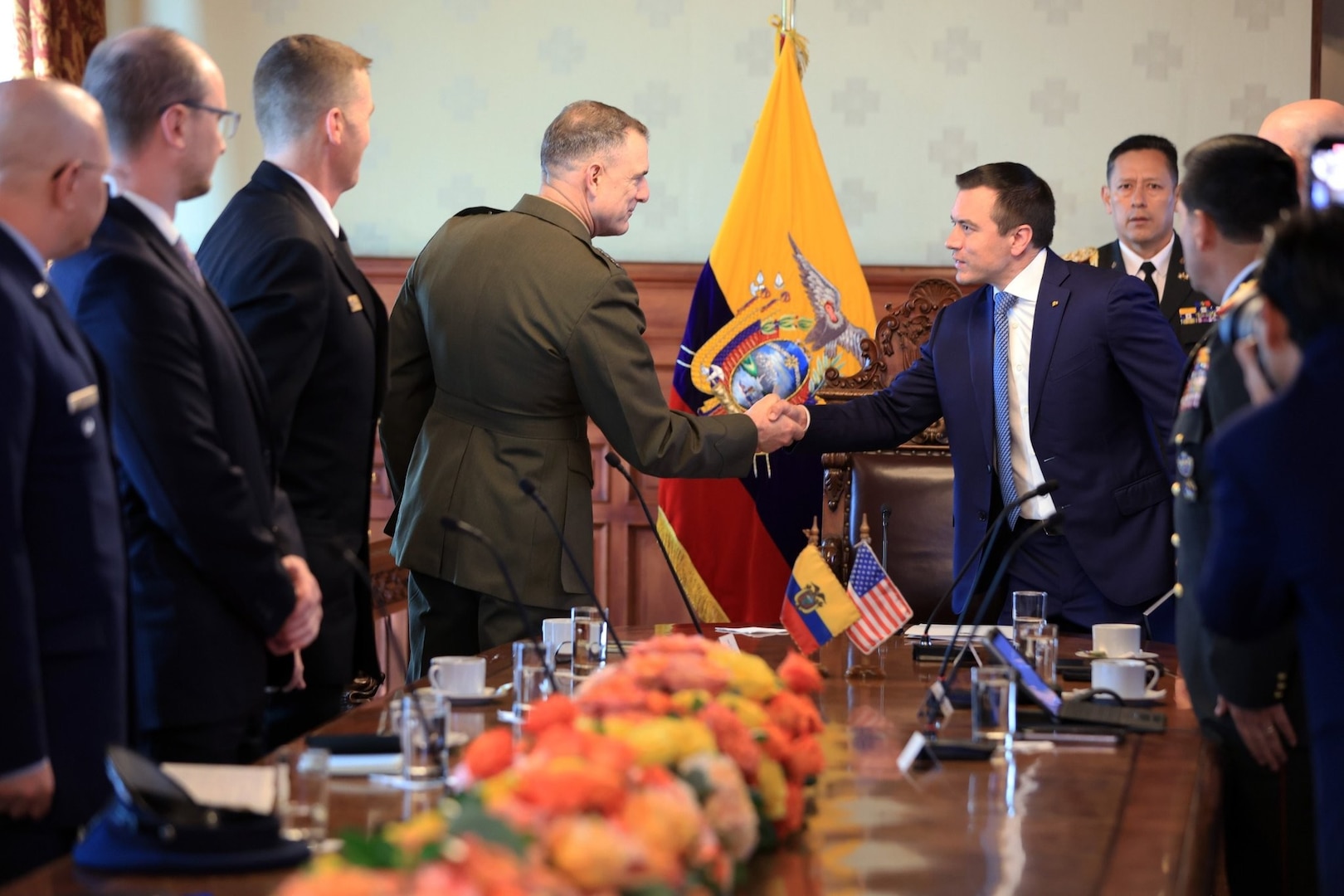
QUITO, Ecuador – On August 24, U.S. soldiers and contractors began ground operations inside Ecuadorian territory, entering the country without a visa under a ministerial agreement signed by the government of Daniel Noboa. The agreement grants U.S. Armed Forces personnel, Department of War employees, and contractors registered under “Commercial Acts and Activities” full immunity from Ecuadorian administrative and legal sanction. Local officials confirm joint operations are already underway in Esmeraldas province, in San Lorenzo, Río Verde, and Eloy Alfaro along the Colombian border, and in Manta, Manabí, where three U.S. Black Hawk helicopters, two warships, and patrol boats have been stationed along transit routes, an escalation foreshadowed by former Homeland Security Secretary Kristi Noem’s November 2025 tour of military facilities in Salinas and Manta alongside Noboa.
This escalation follows the Noboa regime’s June 18 decree authorizing foreign troop deployment while promising pardons, amnesty, and immunity in advance to any soldier, police officer, or civilian who commits crimes “defending the state,” a decree which opposition assemblyman Fernando Cedeño said was drafted in Washington during Noboa’s meeting with Secretary of War Pete Hegseth. Outsourcing the repression meted out by the Ecuadorian ruling class is nothing new for Noboa: he had previously met with Erik Prince, the leader of the infamous mercenary firm Blackwater, to discuss its participation in domestic security operations.
Between March 1 and 6, in the rural border community of San Martín, Ecuadorian forces operating jointly with the U.S. abducted four Colombian farmworkers, waterboarded them, applied electric shocks, staged mock executions with unloaded weapons, and threatened to cut off their fingers, all while demanding they confess to drug trafficking ties they had no connection to. Soldiers then burned the dairy farm where the men worked to the ground and, three days later, struck it again with three air-dropped MK-82 bombs, one of which failed to detonate and bounced into Colombian territory, sparking a diplomatic incident. U.S. Secretary of War Pete Hegseth personally reposted footage of the strike, writing, “we are bombing Narco Terrorists on land as well.” Ecuadorian and U.S. authorities named it Operation Total Extermination. This is the same armed forces that, weeks earlier, had publicly apologized for detaining four Afro-Ecuadorian children in Guayaquil, whose burned remains were later found near the Taura Air Base, a case that sent sixteen soldiers to prison but did nothing to slow the pace of militarization.
By land as by sea, U.S. Imperialism terrorizes the Ecuadoran masses, and does so without shame. The Pentagon does not hide its extrajudicial executions; it celebrates them. Secretary of War Pete Hegseth has boasted openly of the campaign, “Biden coddled terrorists, we kill them.” The death toll stands at over 225 people killed by these attacks within a single year across the Caribbean and Pacific.
None of this has occurred in a vacuum. Since Ecuador’s crisis of bureaucrat-capitalism accelerated in 2020, more than 25,000 people have been killed, with 2025 alone seeing 9,216 homicides, the highest on record and a 32 percent increase over 2024. Noboa has used that carnage, now the second-highest homicide rate in the hemisphere, to consolidate the rule of a comprador state-monopoly bloc fused with foreign, primarily U.S., finance capital. Ecuadorians voted 61 percent against Noboa’s referendum to legalize foreign bases just last November. He is imposing them anyway, by decree, the latest chapter in a subordination that runs back through the 2022 United States-Ecuador Partnership Act, rammed through without a vote of Ecuador’s legislature, to Rafael Correa’s brief, now-reversed defiance: expelling a U.S. embassy security official in 2009, declaring the U.S. ambassador persona non grata in 2011, and ordering American military personnel out of the country entirely in 2014.
This is not a war on narco-trafficking. It is the consolidation of a comprador state, one whose ruling class trades sovereignty, farmworkers, and fishermen for Pentagon patronage, following the same arc as Fujimori’s Peru, the same U.S. imperialist project already tearing through the hemisphere. The torture, the disappearances, the bombing across borders are manifestations of the regular operations of imperialism. Only the organized power of the Ecuadorian masses, in solidarity with the workers and oppressed peoples of the globe, can turn the tide against the imperialist system and its hegemon of U.S. Imperialism.