This piece was submitted to the Editorial Board of The Masses in commemoration with the one year anniversary of the so called ceasefire between the forces of the Palestinian National Resistance and the Zionist Entity.
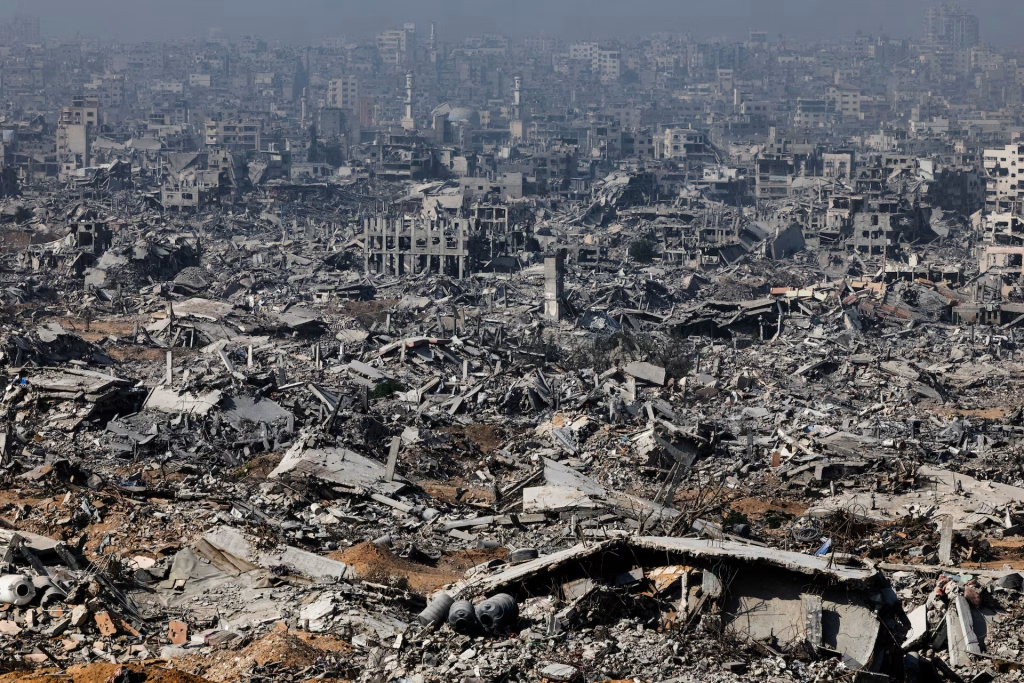
PALESTINE – The genocidal Zionist war of annihilation against the Palestinian people has continued unabated, despite pretenses of a ceasefire agreement. On October 11, 2025, a ceasefire between Hamas and the Occupation was officially signed, and the most intense battles between Zionist ground forces and Palestinian National Resistance fighters subsided, leaving Palestine in a state of disaster and political uncertainty. Though the ceasefire was signed, the conditions of war have persisted. Palestinians still live in clusters of tents wedged between bombed out neighborhoods, hospitals still report operational crises from a lack of fuel for their generators, and survivors of the ongoing genocide are still forced to beg for donations from across the world simply to afford shelter, medicine, and food.
The promises of increased aid flows, heavy machinery, reconstruction, and Zionist withdrawal written into the ceasefire failed to appear, even as Hamas fulfilled its end of the agreement. While its most intense military phase may have been paused, the Zionist campaign of annihilation against Palestine and its people has not ended. Zionist forces continue to kill entire families, children, journalists and reporters, medical workers, and aid workers. Having faced an intractable tactical defeat against the Palestinian Resistance on the ground, the Zionist Entity has used its State apparatus to mobilize a total offensive of its hard and soft power to continue the war. Settlers storm Al-Aqsa Mosque regularly, Zionist bureaucrats strangle aid flows, settler gangs terrorize and evict Palestinian residents in the West Bank, and the Knesset has enacted a discriminatory death penalty law legalizing the hanging of Palestinians convicted of crimes under Zionist law.
The conditions of deprivation and famine still reign as the wider war in the region rages. The U.S.-Zionist war on Iran and escalations across West Asia have drawn global attention away from the ongoing humanitarian catastrophe in Palestine. The machinery of exploitation that takes wealth and life from the masses is still in operation, even and especially in a catastrophe zone as desolated as Gaza in Palestine. Zionist forces are entrenching control behind an expanding Yellow Line, while proposals for restricted reconstruction zones threaten access to housing and the means of survival. Ultra-reactionary Finance Minister Bezalel Smotrich has explicitly demanded annexation up to the Yellow Line.
On the other side of the Yellow Line, Hamas’s civil governance administration attempts to maintain some level of organized life while fighters hunt down Zionist funded militias and aid pirates sent over the Yellow Line to make life in Palestine harder by whatever means they can. Zionist drones, snipers, tanks, and turrets fire bullets into tent camps and drop bombs on markets and apartments. It is the aim of the Zionist forces that the Palestinian people not know a day without bombing. Ultimately, the goal of the Zionists remains to liquidate the Palestinian national cause and render their lands uninhabitable, even as the pace of the violence is lower than during the very worst days of the violence.
At the political level, Hamas continues its attempt to build a National Front list made up of the Resistance Factions, including Palestinian Islamic Jihad, which has never before participated in elections, and even many of the more reform minded elements of Fatah and the Palestinian Authority who want Mahmoud Abbas and his faction of collaborators kicked out of power. Whether this gambit of a National Front electoral list will materialize, and, if so, what it will accomplish, is unclear. But as the political level attempts to assemble a new strategy for the struggle for liberation, the people of Palestine continue to attempt to build lives in spite of the current state of affairs.
One such field is education, where Palestinian educators and activists are desperately attempting to prevent a total collapse of the education system that was responsible for one of the highest rates of advanced education per capita in the world prior to the total destruction of the physical infrastructure. Al Jazeera reports: “Before the genocide, the education sector in Gaza was thriving. Despite the occupation and blockade, we had one of the highest literacy rates in the world, reaching 97 percent. The enrollment rate in secondary education was 90 percent, and the enrollment in higher education was 45 percent.” Groups such as Anera, a Levant activist group centered around humanitarian aid, are attempting to keep this system afloat, establishing schools in refugee camps and attempting to address the needs of those students who have lost so many months and years of their lives and learning to the endless Zionist bombardment that continues even now. Anera reported: “Across Gaza, nearly 400 temporary learning spaces now operate in tents, damaged buildings, and community centers. They reach roughly 220,000 learners, about a third of the school-aged population. Most children attend only about three hours a day, three days a week. The report is clear that these spaces keep children connected to routine and to each other, but cannot replace a real school system.”
Other efforts to redress the collapse of Gaza’s education system come from the residents themselves, using their limited access to donations to rebuild, such as the Phoenix Library, which opened in April 2026, the first library to open in recent years of genocide. These efforts show a commitment to knowledge and revolutionary resistance under the most hostile conditions. Across Gaza, teachers and students have continued studying amid destruction even as nearly the entire educational infrastructure has been damaged.
Palestine will be free, and her people continue to work against the occupation. Longer term and larger scale plans include the reconstruction of permanent schools and higher education facilities throughout Gaza, of which 93 percent must be rebuilt. But these plans, and any other durable reconstruction projects, are dependent on the flow of aid, the national sovereignty of Palestine, and the end of the Zionist occupation.
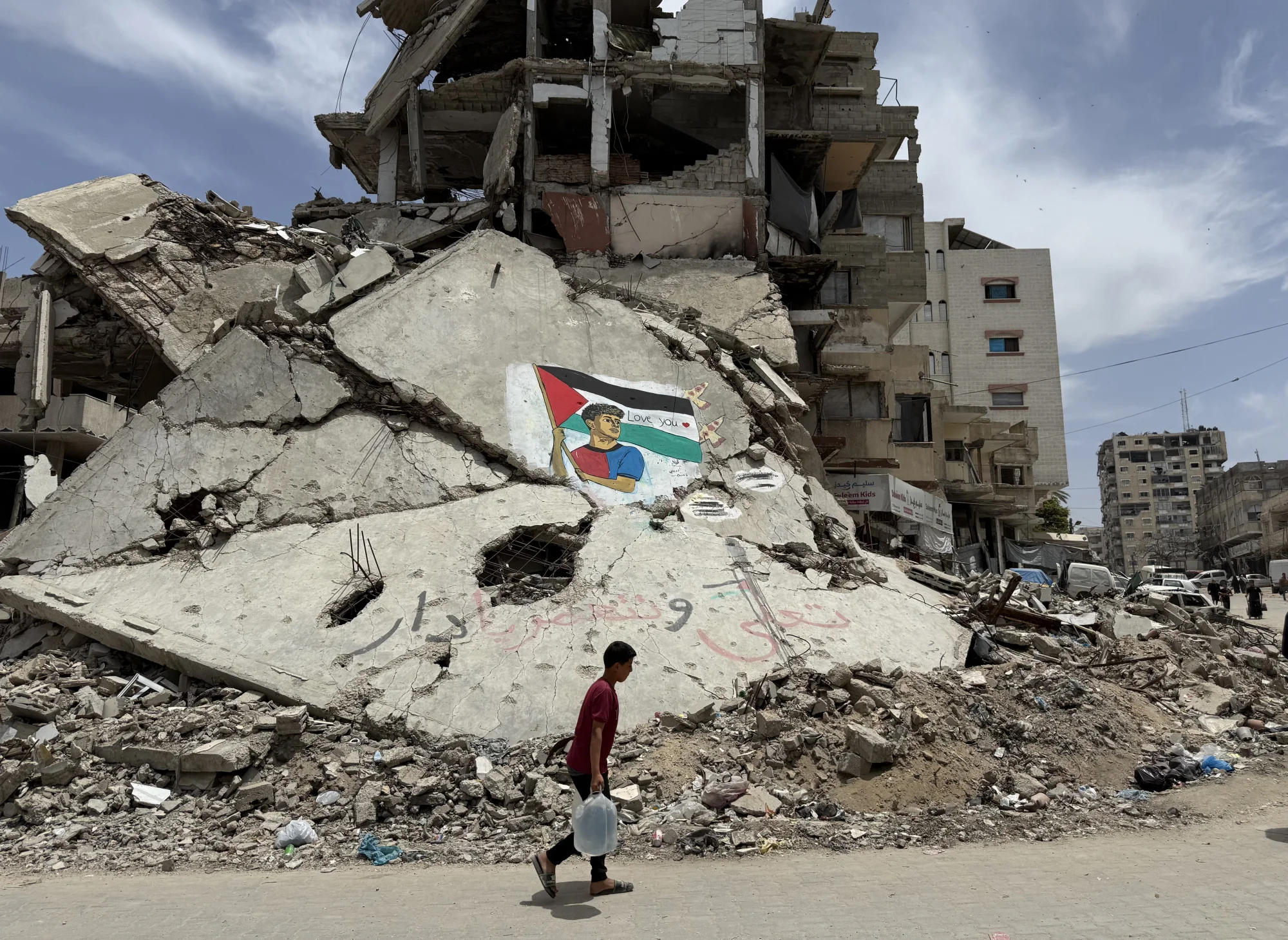
[Image Source: A Palestinian child carries water past a mural of Spanish soccer star Lamine Yamal that is painted on the rubble of a home destroyed by Zionist airstrikes, in Al-Shati refugee camp, Gaza, on May 14, 2026. Anas Baba/NPR]