BRAZIL – Social fascist Luiz Inácio Lula da Silva won the October 25 presidential runoff with 51.79% of valid votes, defeating reactionary Flávio Bolsonaro’s 48.21%. Lula came from behind after finishing second in the first round, denying ultra-reactionary elements in Brazil the presidency while preserving the Old State through which Brazil’s landlords, bureaucrat capitalists, and comprador capitalists exercise their power.
Flávio Bolsonaro, son of Former President Jair Bolsonaro who remains under house arrest and a 27-year sentence for an attempted coup, reached Miami October 28. Flávio travelled through Argentina and Ecuador, with visas from the Trump government. He circulated a letter declaring himself the “true president,” then replaced it with a version calling himself “the leader of Brazil.” He left following a passport-surrender order in a money-laundering investigation, denying any wrongdoing.
Flávio’s Liberal Party secured 121 lower-house seats and is expected to hold 28 Senate seats in 2027. Bolsonaro’s presidential defeat therefore leaves a strengthened reactionary party inside the constitutional machinery. Lula’s negotiations with these forces preserve their institutional power while demanding restraint from workers and peasants. The Workers’ Party, known as PT, markets this class conciliation as the “rescue” of democracy, channeling opposition to Bolsonaro back into the institutions defending landed property, monopoly capital, and imperialist domination.
Lula’s class commitments appear in his economic program. Finance Minister Dario Durigan promised to preserve the fiscal framework and control mandatory spending. In August, he announced a budget freeze of 17 billion Brazilian reais. Such restrictions place health and education under continuing pressure while protecting payments of interest to creditors. The masses demand staffed hospitals, functioning schools, and improvements to their living conditions. The PT solicits their votes while subordinating these demands to capitalist budget discipline. Congress’ October 16 constitutional amendment provides two weekly rest days and a phased reduction from 44 to 40 hours without reducing pay. The PT would turn this gain into renewed confidence in its class collaborationist leadership.
Lula’s environmental platform accompanies an economic program built around oil, mining, agribusiness expansion, and conflict with Indigenous communities. His government backed oil exploration at the mouth of the Amazon, while Vice President Geraldo Alckmin promised to accelerate the Ferrogrão railway, a grain-export corridor threatening Indigenous territories. Indigenous communities withdrew from the government’s conciliation process over the railway in March 2024, but the government has continued pursuing the project. On August 19, Guarani-Kaiowá families at Aratikuty faced a forced eviction by Mato Grosso do Sul police, tear gas and the destruction of shelters. Lula’s false promises of reconciliation have failed to secure the territorial rights of Indigenous peoples and serves as cover for environmental destruction and national oppression.
Lula’s appeals to sovereignty likewise coexist with cooperation with U.S. Imperialism. On August 10 and 11, agents linked to the U.S. Embassy visited prosecutors and border-security agencies in Acre, discussing information sharing and further training. U.S. Imperialism retains access to the repressive machinery defending landlord rule and monopoly capital in the Amazon, sharpening the threat against peasants and Indigenous communities resisting dispossession.
Through his BRICS partnerships, Lula also cultivates relations with Chinese Social-Imperialism, seeking additional partners for the exploitation of Brazilian labor and resources. In June 2025, the federal petroleum agency auctioned 19 exploration blocks in the Foz do Amazonas basin to interests involving U.S. and Chinese capital. Rival imperialist powers compete for access while the local ruling classes bargain over their share. Lula presents these arrangements as national development, preserving the dependent economic relations on which bureaucrat capitalism rests.
Against this background, a revolutionary boycott campaign challenged the claim that another Lula presidency could resolve contradictions rooted in the Old State’s class foundations. Its organizers used political study and street agitation to connect opposition to the far right with a struggle against landlord rule and imperialist domination, maintaining political independence from the PT’s electoral coalition.
Boycott committees in Brasília and in Sorocaba brought together workers, students and teachers to debate the character of the Old State and organize outside the electoral parties. In Brasília, activists distributed 300 leaflets at the University of Brasília on September 10 and held an evening debate in Taguatinga. Participants denounced the persecution of peasants in Rondônia and defended the League of Poor Peasants, linking the boycott to the struggle for revolution.
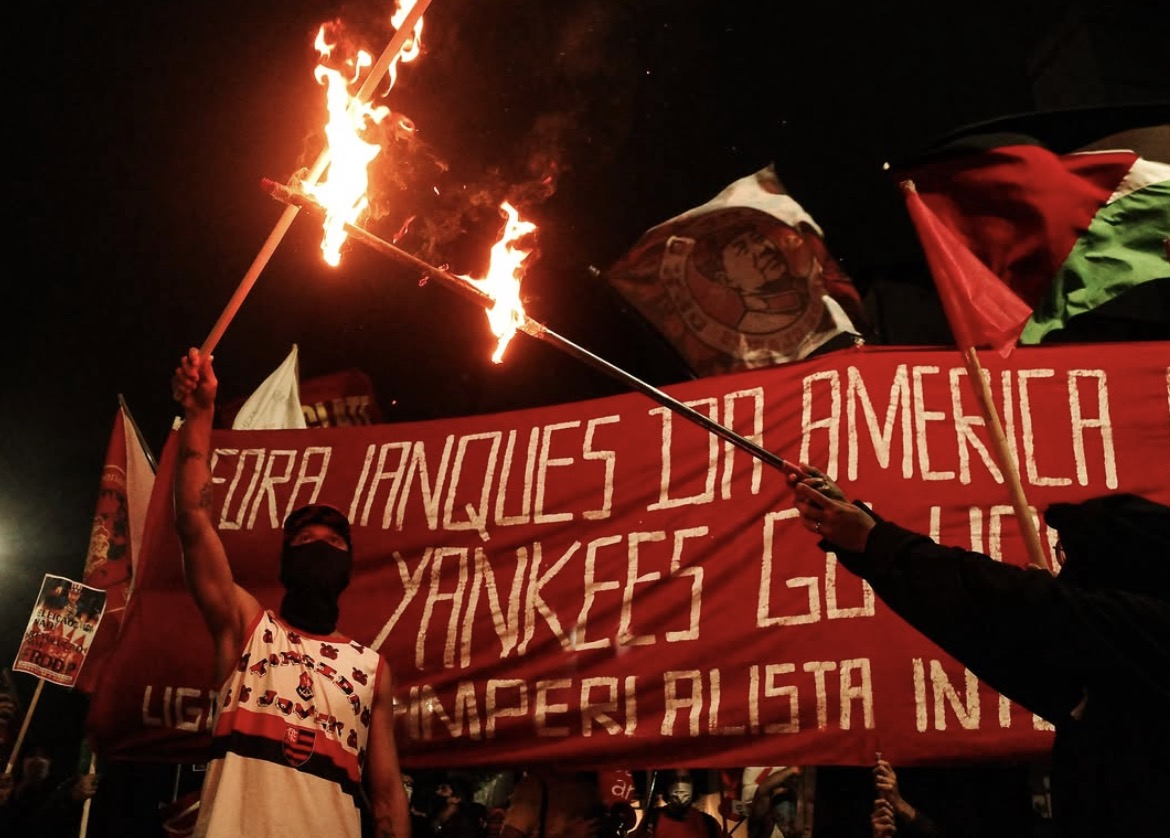
The campaign also reached railway stations, bus terminals and street markets. On October 2, activists distributed manifestos to workers and commuters, handing out more than 2,000 copies around Rio de Janeiro’s Central do Brasil and hundreds more outside Celso Daniel station in Santo André. On October 21, student and popular organizations took part in a street demonstration in Tijuca. Demonstrators burned U.S. and Zionist Entity flags, denounced imperialist intervention, and promoted the electoral boycott ahead of the runoff. These activities connected the campaign against electoral illusions with organized opposition to the ultra-reactionary forces and support for the revolutionary land struggle.
The boycott campaign’s program advances against the landlord domination, bureaucrat capitalism, and imperialist dependence preserved under Lula. It places the worker-peasant alliance and the struggle for political power at the center of a revolutionary alternative to the class conciliation through which the PT administers the Old State. By defending the revolutionary struggle for land, developing independent mass struggle toward New Democracy, and confronting the landlord power that sustains both Bolsonarism and Lula, the campaign put into practice the revolutionary slogans shared in a joint statement of several student and youth organizations:
Dare to struggle, dare to win!
It is right to rebel!
[Image Source: Arapuka Movement and other popular organizations demonstrate in Tijuca October 21]