CROCKETT, CA – On June 15, factory workers at California and Hawaiian Sugar went on strike demanding health and retiree benefits, including sick pay and overtime protections. The strike carried a second, equally central demand: solidarity with the Filipino people following the April 19 massacre of the Negros 19 in Toboso, Negros Occidental, carried out by the reactionary Armed Forces of the Philippines, or AFP. Lyle Prijoles, a Filipino-American activist from Hayward, California, and a leader of the International Coalition for Human Rights in the Philippines, or ICHRP, was one of those killed.
Crockett, or “Sugar Town”, a company town south of the Carquinez Bridge to Vallejo, is home to ninety-five percent of workers employed by C&H Sugar. Much of the sugar that is refined and processed originates from Negros Occidental and Hawai’i, harvested through the blood, sweat, and exploitation of Philippine workers and peasants and the workers of the Bay Area. Some of the factory workers have familial ties to C&H Sugar, following in the steps of their parents and grandparents who worked there.
C&H Sugar, an independent company until its 2006 acquisition by American Sugar Refining, has seen worker exploitation and impoverishment intensify under its new ownership. A 2009 contract between C&H Sugar and the International Longshore and Warehouse Union, or ILWU, had already stripped benefits from any worker hired after that year. Sixteen years later, the workers found themselves at the mercy of company management. C&H Sugar’s desperate bargaining proposed the revokement of health benefits from all retired workers, before and after 2009. The workers, including their retired family members, were at risk of losing their health insurance, forcing them to pay exorbitant prices for medication and doctors’ visits.
The proposed contract would also strip workers of California’s standard time-and-a-half overtime pay, normally guaranteed after eight hours of labor in a single day. That protection is not incidental to these workers’ income: eighty percent of C&H Sugar factory workers work twelve-hour shifts every day, and another ten percent work a minimum of 60 hours per week, with some workers relying on overtime for half their total pay. Eliminating time-and-a-half protections would cost these workers up to $10,000 in annual income, cutting their hours and wages to extract additional profit for the company. The proposed contract would also weaken seniority protections, giving management the power to impose unpredictable schedules, forcing workers through three consecutive twelve-hour shifts and then sending them home without pay for a day at a time.
The proposal would also cut sick days from ten to five, leaving factory workers with families vulnerable to discipline, or termination at worst, for taking time off to care for themselves or their children when ill. Facing these conditions, the workers drafted a counterproposal of their own, demanding the security of these existing benefits. When C&H Sugar rejected it, they launched a strike that would last over a month.
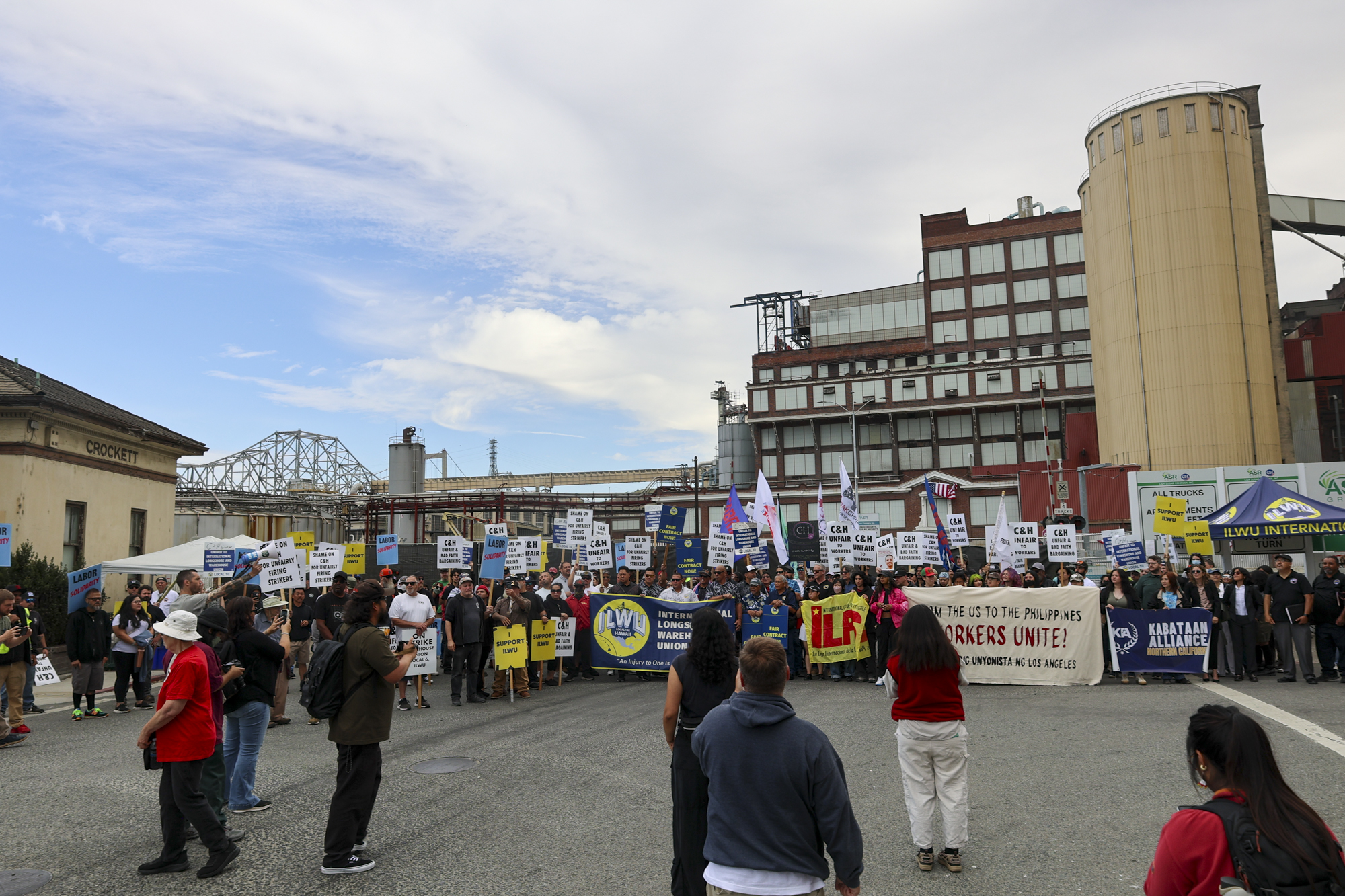
Workers on the picket lines drew a clear connection between their own exploitation in the Bay Area and the conditions facing workers and peasants in the Philippines, recognizing that the fight for C&H Sugar workers’ livelihoods is inseparable from that of Negros Occidental’s sugar cane workers. That recognition translated into direct action: workers were able to prevent a ship carrying raw Philippine sugar from offloading. Workers from China to Hawai’i also voiced solidarity with the C&H Sugar struggle, including Coast Longshore Division members who helped block the sugar cargo from being unloaded.
Ryan Calbreath of international labor solidarity organization BULOSAN drove education, food service, health, and retail workers from Los Angeles to the picket lines in support, declaring that C&H Sugar “directly benefits from the suppression of farmworkers in Negros and other parts of the world.” Supporters also noted the health hazards that come at the price of both Filipino and Bay Area workers. Around the factory, contaminants, including petrol, coal, cement and glass, were in areas where sugar was dumped; they could not be filtered out, leaving workers at risk on the production lines.
In Negros Occidental, sixty percent of the land is dedicated to sugar production, with the average farmer earning less than a dollar a day. In the semi-feudal, bureaucrat-capitalist conditions of the Philippines, the peasants are subject to poverty, food insecurity, displacement to the urban centers, and ruthless land exploitation by the big landlords. The government, currently run by Ferdinand Marcos Jr., ensures profits flow from workers and peasants into the hands of U.S. Imperialism and its beneficiaries.
The recent signing of the Critical Minerals Deal and PAX Silica initiative will further subject the country to the theft of natural resources and displacement of millions of farmers and Indigenous peoples. Peasant farmers are terrorized and murdered by the Filipino reactionaries, and when they are completely alienated from any role in production, they become trafficked labor for the AFP and the Department of Migrant Workers. In spite of this, the peasant masses, under the leadership of the Communist Party of the Philippines, New People’s Army, and National Democratic Front, continue to resist the rule of the exploiting classes in Filipino society. The same class interests that murder and terrorize the workers and peasants in Negros Occidental are those that repress the workers of C&H Sugar.
On June 25, four ILWU warehouse workers on the picket lines were terminated by the company’s Human Resources department, including one raw sugar operator who worked at the factory for over forty years. Private security officers, management, and out-of-state scab workers have collaborated to repress the C&H Sugar workers from attaining their demands. Contradictions reached boiling point on July 21, when Contra Costa County sheriffs, armed with batons, tear gas, and K9 dogs, were sent to disperse the picket lines at the intersection of Loring Avenue and West Street, declaring the strike “an unlawful assembly.” Two scab trucks plowed into the workers earlier that day, leaving ILWU members injured. The police proceeded to attack and arrest ten of the workers in retaliation, but the workers themselves did not let their guard down against attempted repression, continuing to strike.
After over a month of picketing, the workers returned to the shop floor in late July once C&H Sugar and ILWU reached an agreement to extend negotiations for a fair contract, meaning the workers would work through September 30. The unity of C&H Sugar workers in the Bay Area and their connection to the struggle in the Philippines is a clear representation of the power of the international proletariat to defy and struggle for economic-political demands and the seizure of power from the ruling class.
Despite countless attempts and strategies to divide and suppress the multinational proletariat of the U.S., it was the strong presence and initiative of oppressed nationalities and national minorities within the class, workers with direct material and familial ties to the Philippines, that drove the C&H Sugar struggle to become one of internationalism. There is no other class that can lead and emancipate itself from oppression and exploitation than the international proletariat. Only through the victory of the common cause of the world’s exploited and oppressed peoples and nations can U.S. Imperialism, and the international imperialist system itself, be defeated once and for all.
[Image Source: Protesters gather outside of the C&H Sugar refinery in Crockett at the end of June. (Courtesy of Roy San Fillipo)]


