
UNITED STATES – U.S. Imperialism has publicly acknowledged for the first time that it operates weapons in Earth’s orbit, marking another escalation in the militarization of space and expanding the struggle among the world’s imperialist powers over military supremacy beyond the atmosphere into the final frontier. The arsenal circling above the Earth stands as declaration that no domain, including outer space, will remain outside the inter-imperialist struggle for domination, redivision, and conquest.
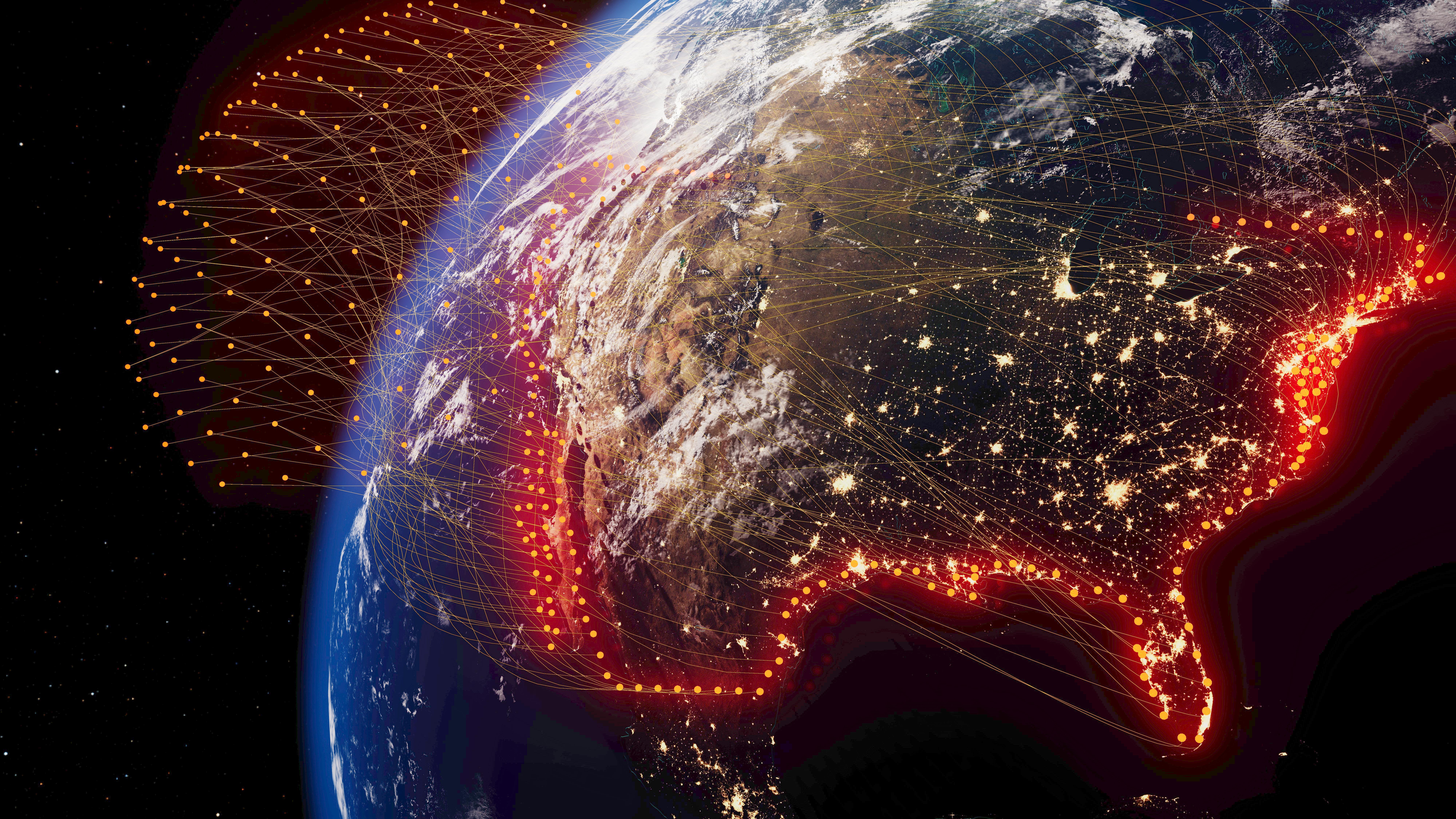
Secretary of the Air Force Troy Meink announced in September that the United States possesses “on-orbit space control weapons,” while Space Force chief Douglas Schiess subsequently confirmed that personnel were already operating such systems. Pentagon officials have refused to publicly identify the weapons, disclose how many are in orbit, or explain their capabilities. At the same time, U.S. Imperialism is pushing forward with the Golden Dome, a massive missile defense architecture built heavily around space based sensors and interceptors. The program’s projected cost is roughly $185 billion over the next decade, while the Congressional Budget Office estimates that a national missile defense system broadly matching the ambitions laid out for Golden Dome could cost about $1.2 trillion to develop, deploy, and operate over 20 years.
Satellites already play a decisive role in communications, reconnaissance, navigation, missile warning, and targeting. Increasingly, however, the U.S. military is preparing for direct combat in orbit. Possible counterspace capabilities include electronic jamming, lasers capable of interfering with sensors, maneuverable satellites, and systems capable of disabling or capturing enemy spacecraft. The U.S. Space Force has also conducted its largest orbital exercise to date, involving spacecraft operating across multiple orbits. Under this growing veil of secrecy, the U.S. continues to conceal the nature of these weapons and exercises, expanding military operations in space while withholding information about systems whose deployment threatens the entire world.

Chinese Social-Imperialism has condemned the U.S. deployment, warning that the weaponization of space could accelerate an arms race. Russian Imperialism has likewise called for restrictions on offensive weapons in orbit. Despite these condemnations, both China and Russia possess substantial counterspace systems of their own, revealing the dispute to be a part of the wider inter-imperialist struggle.
Under the global imperialist system, the monopoly stage of capitalism, the world becomes divided among the largest monopoly groups and imperialist powers. This division of the world cannot remain fixed, as the relative economic and military strength of national and economic powers change, the struggle necessarily becomes one for redivision: the redistribution of markets, resources, territories, trade routes, and spheres of influence among competing imperialist powers.
The terrain of outer space is another arena of this struggle for redivision. Military power on Earth increasingly depends upon control of orbital communications, navigation, missile detection, intelligence, and targeting, technologies that also strengthen domestic surveillance and the repressive capacities of the Old State. Dominance in space can therefore provide enormous advantages both in wars abroad and in the expanding militarization of society at home. As competition among the imperialist powers sharpens, the battlefield expands with it, from land and sea to the atmosphere and now into orbit, while the same military infrastructure increasingly reaches inward through policing, border enforcement, surveillance, and repression.
Existing international law places only partial restrictions on this process. The 1967 Outer Space Treaty prohibits States from placing nuclear weapons or other weapons of mass destruction in orbit. It also establishes that activities in outer space remain subject to international law, including the principles of the U.N. Charter. The treaty, however, does not categorically prohibit conventional weapons from being stationed in Earth orbit.
The history of U.S. Imperialism demonstrates that international law offers no guarantee against aggression when it conflicts with the demands of monopoly capital. U.S. Imperialism invaded Iraq in 2003 in defiance of the U.N. Security Council, while the U.N. General Assembly condemned U.S. invasions of Grenada in 1983 and Panama in 1989 as grievous violations of international law and national sovereignty.
The weaponization of Earth’s orbit represents more than a technological development or a new military doctrine. It is another expression of the contradictions produced by the imperialist system, as the major imperialist powers extend their struggle for strategic advantage into an arena that is a common domain of humanity. U.S. Imperialism seeks to preserve its military predominance, while Chinese Social-Imperialism and Russian Imperialism expand their own capabilities in response. The result is an accelerating cycle in which each advance by one power becomes the justification for further militarization by its rivals, pushing the struggle for redivision beyond the Earth itself.
The consequences of this competition will not remain confined to orbit. The enormous resources committed to the Golden Dome, military satellites, counterspace systems, and orbital weapons are drawn from wealth extracted from the masses and oppressed nations. As contradictions among the imperialist powers sharpen, monopoly capitalism turns every new technology and every new domain toward war, exploitation, and repression. The militarization of space is part of the same imperialist system that wages war abroad and deepens militarization at home. The struggle against imperialist war is therefore inseparable from organizing the working and oppressed masses against the Old State and for political power.
[Image Source: Rendering of the Golden Dome missile system]


[1. U.S. Space Force patch, 2026
2. Donald Trump receives Space Force flag, the sixth branch of the U.S. military, in the Oval Office, May 15, 2020
3. U.S. Space Force, Space Launch Delta 30 commander, receives the SLD 30 flag, Vandenberg Space Force Base, Calif., July 8, 2025
4. U.S. Space Force oath ceremony at Air Force Institute of Technology]