
In recent weeks, a number of semi-colonial states have moved to limit and cut relations with the United Arab Emirates, or UAE. States like Algeria itself and Eritrea itself have cut ties directly, both pointing to the Emiratis’ heavy interference in regional affairs and commitment to fueling devastating conflicts and social division in order to sell weaponry and take advantage of disaster zones for war profiteering. Algerian President Abdelmadjid Tebboune had foreshadowed the rupture months earlier. Speaking obliquely about Abu Dhabi, he warned that “wherever they set foot, blood flows,” adding, “We want them to stay away, so that blood does not flow in our country.”
These comments came days before Algeria formally severed ties on September 10th and signaled intentions to allow the formal airspace agreement between the two states to lapse at its end-of-year expiration.
Emirati influence has long sought to exploit institutional weakness and State collapse across the semi-colonial world, aligning closely with U.S. Imperialist interests and Zionist Imperialist interests to expand access to ports, resources, markets, and military infrastructure. Libya, Sudan, Yemen, and parts of the Horn of Africa have all become arenas of Emirati intervention. In Sudan, the UAE has been repeatedly accused of backing the RSF, while in Yemen it has supported separatist militias and maintained a substantial military and commercial footprint. Its expansion is particularly visible through the network of ports controlled or operated by DP World and AD Ports.
The United Arab Emirates’ role as a leading international arms trafficker, energy market, and storehouse for finance capital has allowed it to accumulate massive amounts of political and financial power, stolen from the regions it interferes in. For the working masses of these countries, whether peasants attempting to cultivate crops and maintain their herds or workers carrying out dangerous mining, industrial, and infrastructure labor, the destruction produced by war and political fragmentation undermines the social and political bases from which the people can organize independently. Conflict, displacement, privatization, and the destruction of local institutions create increasingly favorable conditions for foreign, in particular U.S. and Gulf, capital seeking cheap labor, raw materials, ports, and strategic territory.
The latest political system to fracture under the weight of the contradictions of Emirati influence is Ethiopia. Ruled by the Prosperity Party under Abiy Ahmed, Ethiopia has increasingly aligned itself with the UAE and the United States. To fuel its corrupt dictatorship and wars of aggression Ethiopia has become a major Emirati ally, deploying Emirati weapons systems, and having been accused of hosting forces connected to Sudan’s UAE backed RSF.
On September 20th, an ideologically eclectic alliance of seven different political groups announced the formation of the “Ethiopian People’s Forces Alliance for Survival,” or the Alliance for Survival.
This Alliance for Survival is a very broad Popular Front that includes elements which were, until recently, part of the ruling coalition and complicit in war crimes joining forces with the Tigray People’s Liberation Front, which has long had ethnic tensions with the Ethiopian State, most recently with the Tigray War. Other members include the Amhara Fano National Movement, the Oromo Liberation Army, and organizations representing Afar, Somali, and Benishangul-Gumuz constituencies. The groups declared that they would work together to remove Abiy’s government and establish a transitional government.

The goal of the group is nominally to prevent the continued slide of the Ethiopian government into foreign influence, ethnic tensions, and the semi-permanent state of war it has pursued against its neighbors. This declaration comes on the precipice of renewed conflict with Eritrea, a breakaway state on the African coast that the Ethiopian government has fought several wars against, with recent tensions most notably surrounding its Red Sea access.
Eritrea has become the latest state to break relations with the United Arab Emirates, citing its interference in the region and its “port Imperialism”. This break comes as tensions between Ethiopia, Tigray, and Eritrea, in a long-standing zone of tension and brutal ethnic subjugation and conflict, were threatening to break out again. While Eritrea may have been granted independence by the UN, international bourgeois legal mechanisms do not protect from expansionist ambitions. Eritrea’s Red Sea port access has become a massive point of envy for an Ethiopian State that sees itself as superior and deserving of a position of regional dominance. On the same day that the Alliance for Survival announced its own existence, Zionist publication Haaretz published a story titled “In a South Tel Aviv Warehouse, Eritrea’s Democratic Revolution Is Brewing” concerning attempts to foster a new, Zionist-friendly Eritrean government.
Where exactly Eritrea will fall in this nascent civil war is an open question, given its strategic support for Ethiopia in the Tigray War and prior conflicts with the Soviet-backed Ethiopian Derg government. Presently the Emiratis’ bloody handprints are all over the region, on all sides. The growing UAE-Zionist relationship has only intensified Eritrean suspicions. Osman Saleh asked, “We have to ask why Israel is running to control the Horn of Africa? Why do they need a base in Somaliland?” This effort predates the Abraham Accords that have explicitly and openly linked the two American allies’ security interests, but has only grown more intense since their signing. Ansar Allah’s official English-language site provides additional coverage of the regional struggle involving U.S., Zionist, and Gulf interests.
Abiy’s Ethiopian government is itself deeply reactionary, but it remains unclear how politically disciplined, unified, or durable the seven faction alliance will prove to be. Opposition to Emirati influence or Abiy’s government does not by itself resolve the internal contradictions among these forces. What the present crisis does demonstrate is the increasingly destructive role played by foreign capital, weapons, port concessions, and military alliances across the Horn of Africa.
The UAE’s strategy has repeatedly benefited from precisely these conditions. A fractured and unstable region allows foreign powers to purchase strategic access, secure favorable contracts, arm competing factions, and acquire influence at relatively low political cost. Whatever immediate diplomatic reversals the UAE now faces, its bloody footprints remain visible from Sudan and Yemen to Ethiopia and the Red Sea.
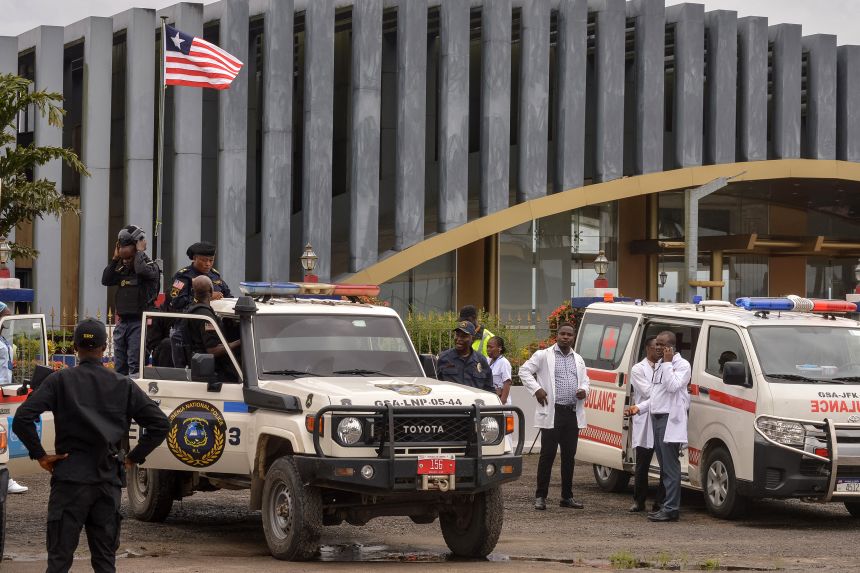
[Image Source: Algerian flag, Algiers, 2026]


[1: Minister of Foreign Affairs for Eritrea Osman Saleh at the United Nations, September, 2025
2: Tigray People’s Liberation Front (TPLF) fighters walk in lines for another field in Mekele, the capital of Tigray region, Ethiopia, on June 30, 2021
3: Eliminated tank husk on the roadside near Gereb Agew, southern Tigray, after clashes between the Ethiopian National Defence Force (ENDF) and the Tigray People’s Liberation Front (TPLF), on March 3, 2026, Abel Gerezgiher
4: Oromo Liberation Army (OLA) fighters attend an orientation session in western Oromia, Ethiopia, on June 2, 2025
5: Ethiopian Prime Minister Abiy Ahmed]