WEST ASIA – The battle being waged for the sovereignty of Yemen by the legitimate national resistance governing from Sana’a, referred to as Ansar Allah or informally as the “Houthis,” has seen tremendous victories against Saudi Arabia and its coalition of proxy forces fighting under the banner of the “Presidential Leadership Council.” The Yemeni Armed Forces and their allied Popular Resistance Committees and militia forces have gained tremendous ground in pushing PLC forces farther away from the coast area, consolidating their previous gains in October, and halting attempted counter-offensives by Saudi-aligned forces both along the northern border and westward toward the coast.
The Yemeni Armed Forces’ combined-arms tactics that utilize formal and informal ground forces with fire and reconnaissance support from drones, missiles, and artillery have allowed the highly disciplined and ideologically motivated forces of national liberation to sweep away the sectarian mercenary armies supported by Saudi Imperialism and its partners. Saudi Arabia has also experienced more blowback from the conflict than it had expected and is sustaining increasing dire ruptures within its economic system. Aside from the high number of Saudi military advisors and officers who have been struck, Yemeni missiles and drones continue to strike vital military, industrial and financial centers all across Saudi Arabia. Saudi Arabia’s expansive U.S. Imperialism-backed air defense system has proven inadequate in protecting the country, leading to a military, economic, and political crisis as important economic assets and the offices of those who manage them become smoldering proof of Saudi Arabia’s inability to defeat Yemeni forces on the battlefield.
The Yemeni Armed Forces, or YAF, have struck crucial oil production sites, military staging points, and corporate headquarters in downtown Riyadh, Saudi Arabia’s capital, exposing the failures of Saudi air defenses and the contradictions in the State’s war propaganda. Saudi official outlets have issued brazen denials that targets were hit despite all available evidence, including the strike on AramCo’s headquarters. These denials accompany attempts to exploit the same military failures to whip up chauvinist resentment and rally domestic support for deepening the more-than-a-decade-long war of aggression against Yemen. The Saudi ruling class seeks to turn its military setbacks into a justification for further aggression, producing an increasingly contradictory and discredited narrative. Meanwhile, Ansar Allah has published hours of footage showing its forces defeating Saudi-backed mercenary armies in the field through bold and innovative tactics, gaining support and legitimacy among some international observers.
Saudi Arabia has responded to these defeats in battle and in the media by escalating the scale and severity of its bombing campaigns, launching hundreds of airstrikes a week on Yemen, often lashing out at civilian targets and even bombing its own forces in the midst of its own confusion. The Saudis’ massacres are much like those they have been committing in Yemen for decades and those committed by Zionist forces across Gaza and the West Bank, Lebanon and Iran. Strikes on schools, markets and tribal gatherings are common and were, at one point, even declared policy before human rights groups complained and the Saudi-backed Yemeni military officials simply acted as if they had never said anything.
The Saudi Arabian strategy of flipping between total denial and hysterical catastrophizing mirrors its political and military shortcomings. As it continually fails to reverse the Yemeni Armed Forces’ lightning progress and additionally fails to diminish Ansar Allah’s political support across the Yemeni nation, Mohamed Bin Salman’s domestic support and retention of investor confidence become weaker. In its desperation, Saudi Arabia has pushed the Mecca alliance, its largely symbolic military pact with Turkey and Pakistan, to deploy troops and provide hard military aid in Saudi Arabia’s time of need. While exact details of their cooperation remain opaque, both Turkey and Pakistan have transferred financial and material support to the war effort.
Saudi Arabia has also made an agreement with Ahmed al-Sharaa’s Syria for the deployment of Syria’s highly sectarian and comparatively battle-hardened forces to positions on both sides of the Saudi-Yemeni border. Saudi Arabia’s penchant for utilizing mercenary forces is well-documented, but rarely is it expressed so directly through a state-to-state agreement between international partners. With Saudi Arabia paying Syria roughly 500 million dollars, the forces are a mercenary band who share an ideological hatred of Ansar Allah’s sociopolitical project. This also provides al-Sharaa, struggling to keep Syria together under the pressure of his own sectarian politics, Zionist aggression, and the structural problems within the Syrian state, a much-needed financial lifeline and pressure release valve for his discontented and disunited security forces. Saudi officials reportedly insisted that the forces be Syrian nationals, signaling their own hesitancy to take on Syria’s foreign-fighter question.
While the loss of its military positions certainly cost Saudi Arabia economically, it is the YAF’s strikes on Saudi oil concerns, with the imposition of their reciprocal blockade, that are the most costly element of the war. The vulnerability of its infrastructure and the mounting long-term damage have serious consequences for Saudi profit schemes. The Saudi economy is underpinned by its titanic role in the global energy trade, an essential component of not only Saudi Imperialism but the greater global imperialist system, which requires the relatively free trade of oil to support global production chains and serve as the backbone of the global financial system. Incidentally, this aspect of the war is also the one the Saudis have the fewest meaningful options for dealing with. The Saudi military is armed to the teeth with the most cutting-edge weaponry and air defense that U.S. Imperialism has to offer, rivaled in the region only by the Zionist Entity, and it has proven wholly ineffective at preventing the YAF from striking sensitive targets across Saudi Arabia. An attempt by Saudi Arabia to pay off Ansar Allah with a billion dollars was reportedly countered with an offer of $51 billion, the total end of the Saudi blockade of Yemen, and the unequivocal recognition of the Sana’a government as the internationally legitimate government.
On the surface, Ansar Allah’s counter-offer being fifty-one times higher than the initial offer may seem ludicrous, but the potential losses that Saudi Arabia will surely eat from its refusal to accept Sana’a’s conditions will be much higher. Saudi Arabia’s oil revenues have fallen to their lowest rate in six years. Already in Quarter 3 of 2026, its quarterly budget deficit doubled as it attempted to spend its way out of the contradictions of its own making. These are the figures that are emerging amidst Saudi Arabia’s attempts to minimize knowledge of strikes on essential productive infrastructure, such as its East-West pipeline’s pumping stations, and of missiles dropping straight into Saudi Arabia’s foreign-investment-dependent industrial zones.
Some bourgeois economists have been chattering about profit being recovered in the rising price of oil, and while this may be the case in a technical aspect, it fails to comprehend the totalizing effects of a global oil supply that is structurally contracting at a rate faster than it can be replaced. With no end to the war in sight, only more infrastructure will be targeted by the YAF’s missiles, and this is without any potential regional explosion in the continued war on Iran by U.S. Imperialism. Faith in the propensity of the market to correct in the long run also misses the larger issue Saudi Arabia faces: if it cannot guarantee the physical safety of its infrastructure, foreign investors will be scared off from future and present business with Saudi Arabia, which has been courting foreign investment and popular approval across the imperialist nations.
Saudi Arabia’s military strategy of mass-murdering Yemeni civilians in Sana’a’s zone of control and total public denial of the consequences of the war are only causing the Yemeni Armed Forces to strike back harder and closer to the heart of Riyadh. The impact on AramCo tower, labeled as ‘debris’ by official Saudi outlets, was a powerful blow to the already fragile narrative of Saudi supremacy over Ansar Allah. Mohammed bin Salman’s denial of Ansar Allah’s legitimate support and national strength, including that of the YAF, reflects the craven idiocy of the Saudi capitalist-imperialist ideology which only digs their own grave deeper with every new commitment to genocidal imperialist war on the Yemeni people and the broader region.
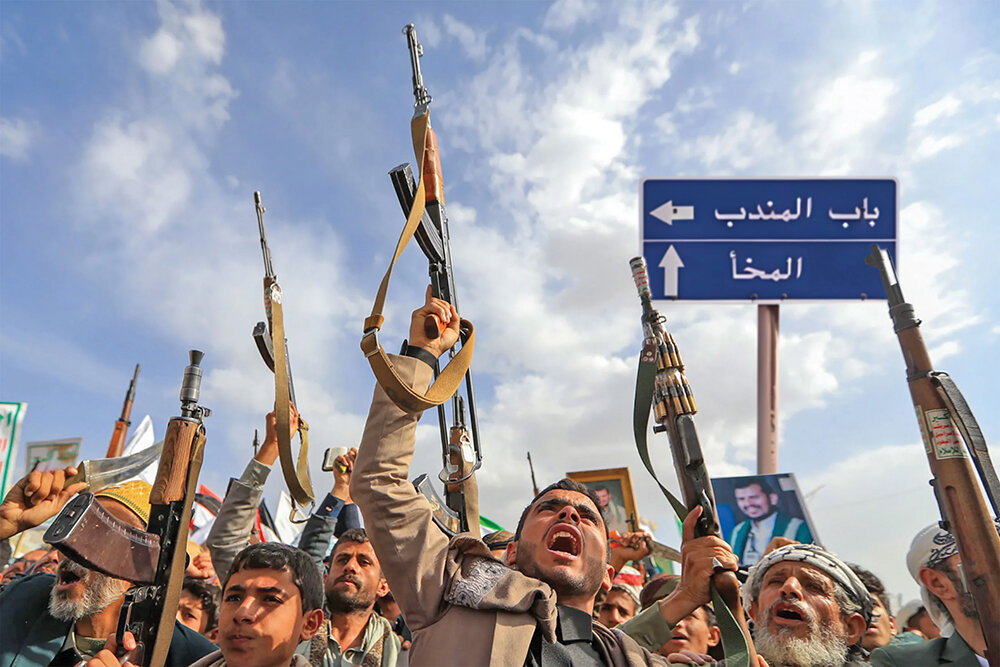
In recent weeks, the YAF have thrown Saudi backed PLC forces not only out of their positions on the Western Coast, but used a PLC attempt at a counter-offensive to kick them entirely out of the Southern coast as well, fully consolidating control over the Bab el Mandab strait from all sides and severely limiting PLC control over essential logistical and strategic positions West of their capital, Aden.
For all the bodies that Saudi Arabia can buy for the meat grinder, its coalition of mercenaries from across the world cannot stand against a force of national liberation. In defending their national sovereignty against imperialist aggression, the Yemeni fedayeen of liberation carry their people’s defiance beyond Yemen’s shores, striking at the machinery of global imperialism and the chains it fastens upon oppressed nations.
[Image Source: The Yemeni Armed Forces (YAF) seize control of the western coast, consolidating hold over Bab al-Mandab Strait]