SANA’A, Yemen – In the early hours of September 9, the Ansar Allah government’s Yemeni Armed Forces began a focused and intense offensive operation down the Yemeni Western Coast to break the Saudi-backed Presidential Leadership Council, or PLC, based in Aden, government’s control over the port of al-Mokha and the Bab al-Mandab Strait.
The attack included waves of missile strikes and drone attacks, mechanized and ground troops, and a political amnesty for those who surrendered, all supported by the local armed militias loyal to the Sana’a government. The result of this fully integrated offensive was astounding. Within 12 hours, the Yemeni Armed Forces, fighting to liberate their country from foreign interference, had made a lightning advance down the coast. One after another, Taiz, the bases surrounding al-Mokha, and entire PLC units fell, with Ansar Allah capturing huge caches of equipment and personnel from UAE- and Saudi-backed brigades alike.
Within 24 hours, the entire coastline, including al-Mokha and the islands within the Bab al-Mandab Strait, had been cleared of foreign-backed mercenary forces, who had all either surrendered, retreated to Aden, or deserted entirely. What initially seemed to be battles forming for important strategic sites on the path to the Bab al-Mandab became minor skirmishes as local garrisons melted to the Ansar Allah advance.


In all of the fighting, no significant defense of any settlement, city, or garrison occurred. The PLC forces made a temporary salient, or bulge into Northern Yemen in the first few hours of the offensive that was crushed before the day was over. The Saudi-backed militias only held territory long enough for the bourgeois press and its parrots to proclaim the final “collapse” of the “Houthi menace”.
This stunning military collapse on the Saudi-backed side, comparable to the collapse of the Syrian Arab Army in January of 2025, occurred after nearly a decade of static battle lines. The offensive transformed long-accumulating contradictions within the Saudi-backed camp into open military collapse. The Yemeni Armed Forces are a highly skilled fighting force, from their paramilitaries to their formal units, and they are armed with artillery, drones, and missiles that are in total harmony with their doctrine.
But the Saudi-backed Yemeni Armed Forces were also well armed, and had technological and strike advantages, particularly with bombs and jets, that the relatively cash-poor Ansar Allah could not afford. The Sana’a government’s political and military command is far more effective at identifying geopolitical and structural weak points within their enemy, giving them strategic options that their opponents lack. Their arsenal and doctrine have greatly regulated and improved in the years since the last serious clashes with their Southern and Eastern opposition, while the opposing forces grew complacent and internally agitated. The competition between Saudi Arabia and the Emiratis flared up into a brief scuffle last January, 2025, but is flaring up again as Saudi forces retreat to bitter Emirati forces’ positions.
There is also the Saudi military’s abysmal leadership of their forces. Local ground-level officers reported their leadership abandoning them, not lending them air support or adequate resources to defend themselves, and otherwise behaving recklessly with their proxy forces, sending them into ill-advised and outright stupid military moves. Paramount were the strikes on Sana’a airport after Ali Khamenei’s funeral that caused Ansar Allah to declare a blockade on Saudi oil. Their senseless escalation, brutality, and apathy for the conditions of their proxy forces all led to brutal discontent and a lack of will to fight past one’s paycheck.
All of these military, political, and structural answers are rooted in the fundamental root of the Sana’a government’s authority and strength: Ansar Allah’s distinct “walled garden” model that places immense emphasis on self-determination and political power for the peasant class, and their genuine commitment to principled national sovereignty, independence, and anti-imperialism.
The true strength of this system is its ability to ideologically educate and radicalize not only the political class and the military, but the Yemeni Masses. Using clerical and tribal influence networks, along with Ansar Allah-backed local militias, they have been able to effectively ensure that the Yemeni masses are ideologically educated and committed to their national liberation and military stand against the U.S., Zionist, and Gulf attempts to impose domination on their people.
On the contrary, the forces loyal to the Saudi-backed government fight for nothing but the checks and equipment they receive. There is an eclectic mix of ideological elements within these forces, ranging from Saudi-aligned Sunni supremacists who were educated in Saudi masjids to sincere Southern Separatists who felt their autonomy had been destroyed in the reunification effort of the 90s, which looted South Yemen for the relatively backward Northern elite’s benefit. But the uniting factor of these tendencies was Saudi and Emirati capital. And so, when a true national liberation movement whose loyalty is with their people, immune to bribery and unmoved by terror in the face of one of the world’s most brutal bombing campaigns, came knocking on their door, they simply dissolved.
The Ansar Allah offensive is currently driving toward Marib, to Sana’a’s east, rather than driving to Aden, where the Southern government sits, with operational capacity likely lying in a hotel in Riyadh. Marib contains oil-rich regions that would give the cash-strapped Ansar Allah government far more freedom of action through reclaiming the oil revenues currently being looted by Saudi Arabia and Yemeni capitalist collaborators. The Trump government has deployed roughly 200 military advisers to Saudi Arabia to help them coordinate their bombings of Ansar Allah territory. Preferring settlement to conquering with the legitimate grievances of the South, the Sana’a strategy is aimed at cutting Saudi and Emirati influence out of the country, leaving a settlement as the only option for their opposition.
Only time will tell how the ongoing struggle in the region will end; by some accounts it may drive all the way to Mecca and Medina. What is clear is that the geopolitical balance of the region will be changed in ways both expected and as yet unimaginable.
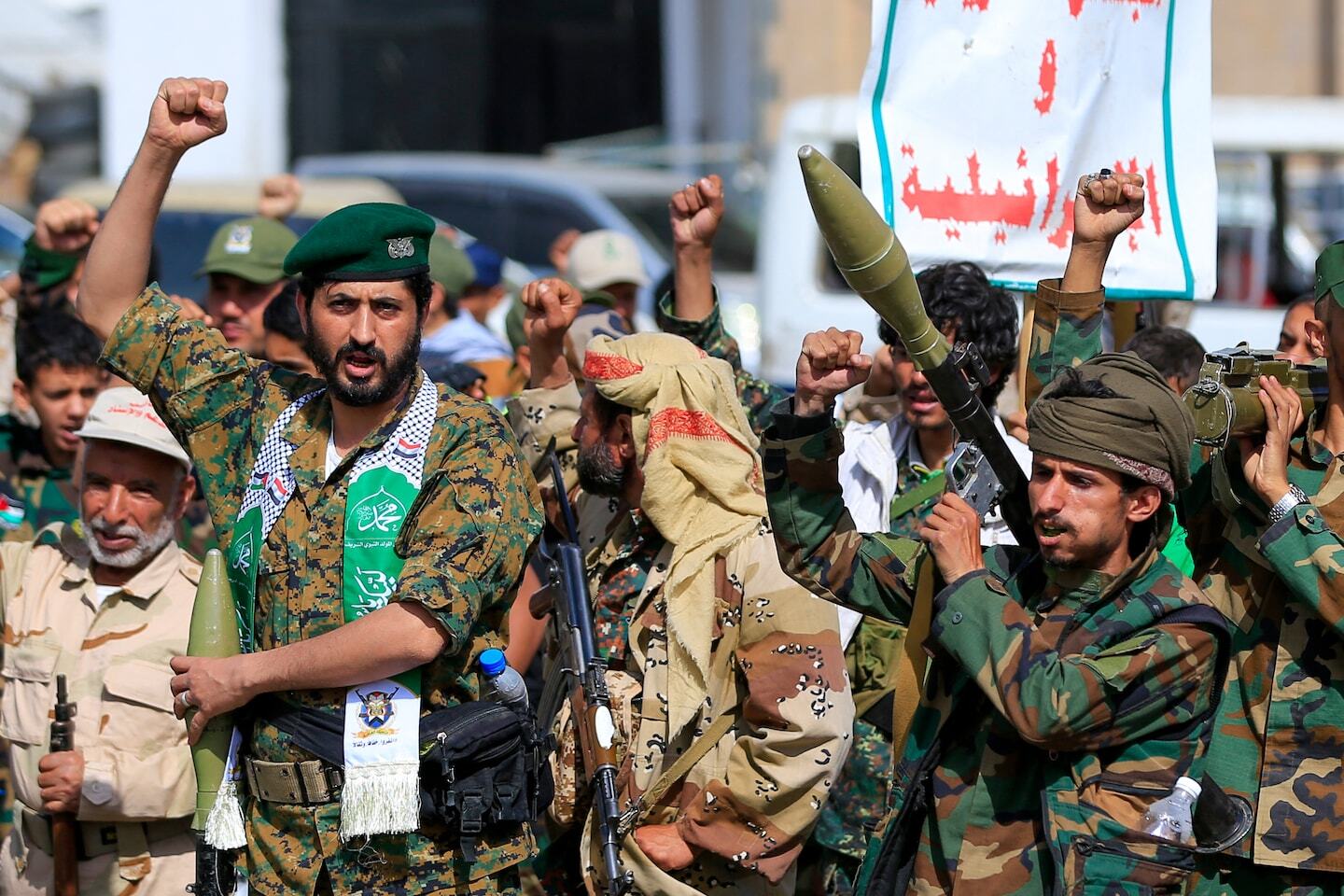
[Image Source: Ansar Allah fedayeen take part in a recruitment drive in Sana’a on Thursday. Photograph: Mohammed Huwais]


[1: A person walks past the shuttered Saudi embassy with a graffitied wall depicting a Ansar Allah fedayeen stopping a ship off the coast of Yemen, in Sanaa, Yemen, September 11, 2026, Yahya Arhab/EPA photo.
2: Ansar Allah Media Office photo, Ansar Allah fedayeen firing a truck-mounted anti-aircraft gun during an attack on Saudi-backed forces in eastern Jawf province, Yemen.
3: Ansar Allah fedayeen carries a rocket-propelled grenade launcher as they march during a mobilization campaign in Sanaa, Yemen, on September 10, AP photo.
4: Ansar Allah fedayeen Political leader Mohamed al-Houthi sitting in an artillery gun in the liberated coastal area.
5: Saudi east-west pipeline Ansar Allah struck.
6: Ansar Allah fedayeen take part in a recruitment drive in Sana’a on September 10.
7: Ansar Allah fedayeen take part in a recruitment drive in Sana’a on September 10.
8: Military spokesman for the Ansar Allah, Brigadier General Yahya Saree]