
ALBANIA — For Albania, 2026 will be remembered as the year of the so-called Flamingo Revolution, another manifestation of petty-bourgeois frustration, especially among the youth, at the corruption, anti-democratic tendencies, and environmental destruction that are fundamental to the framework of bourgeois political life, rights, and State power.
This “revolution” began in February as a protest movement of a dual character, critical of the environmental impact of the Blue Borgo tourist development as well as the state corruption surrounding land titles that made the development possible.
Over the following months, similar environmental based demonstrations, especially those surrounding the investments of the Trump clique on and near Sazan Island, came together in the cities, away from the construction sites, and began to link their basic and immediate demands to political ones. A Protest Coordinating Group was organized, and a set of demands was made. These demands are strictly reformist, including the removal of the Prime Minister Edi Rama, anti-corruption measures, and environmental protections. Recently, October 26, the government announced repressive measures, including fines, restrictions on assembly, and a special police registry of people suspected of protest-related offenses. The October 31 demonstration proceeded despite the new penalties, with police deploying water cannons against protesters. On November 2, students organized class boycotts at multiple university faculties in Tirana, entering lecture halls and urging classmates to participate.
The protesters have favored the history of Albanian bourgeois nationalism of the Prizren era over the heroic anti-fascist or socialist movements and figures with which the history of the nation is replete. This should give some indication as to the class character of these events.
By October, teachers and professors had joined the student mobilizations demanding Prime Minister Edi Rama’s resignation. On October 26, the government announced repressive measures, including fines, restrictions on assembly, and a special police registry of people suspected of protest-related offenses. The October 31 demonstration proceeded despite the new penalties, with police deploying water cannons against protesters. On November 2, students organized class boycotts at multiple university faculties in Tirana, entering lecture halls and urging classmates to participate.
A much clearer indication of the class character is the high-level participation of Eva Kushova, a notable representative of the movement who gave a significant number of interviews to the bourgeois press under the guise of a “Sustainable tourism campaigner.” The press, most of the time, neglected to identify her as the head of Destination Management Organization, whose stated mission is “to promote Albania by highlighting and marketing the rich diversity, history, landscape, and culture…” The above-mentioned demands have 13 signatories, all of whom are petty-bourgeois or semi-proletarian, such as architects and IT professionals. The clear ideological limits of the protest demands are reflective of the class character of the protesters and their leaders. For the protesters, the problem isn’t the basic organization of their (tourist) economy; it’s that it isn’t sufficiently regulated. Therefore, it doesn’t seem strange that the anti-tourism-development movement is represented by a head of the tourism industry.
Two years ago, Law 21/2024 was implemented, lifting development restrictions on “protected land” that was formerly considered public. A scientific analysis of this curious phrase reveals the nature of the rest of the land not set aside for protection: it is unprotected. There is nothing the masses, through the apparatus of the capitalist State, can do to influence what goes on there, nor do they have the right to criticize it. This is the logic of capital manifest in bourgeois rights. In the end, the problem is understood as one of “bad government” rather than evolving into a criticism of imperialism.
The petty-bourgeoisie are not wrong the the lands of Albania belong to Albanians. What they don’t understand is that this doesn’t mean Albanians should be free to sell their land to the highest bidder, after all, it was Albanians who cut the land deals with Trump and other imperialist interests; the land should be utilized by Albanians for their own development. The former option would constitute a national right, which need not necessarily be a bourgeois one.
It is incumbent on the petty-bourgeoisie to also realize that, unless they follow the leadership of the exploited workers and establish a people’s republic, there is no means of protecting the land of Albania from detrimental foreign investment or equally harmful developments financed by domestic capital. They cannot lead themselves, as evidenced by the events of the year; they can only take up the leadership of another class. For now, they are being led astray, thinking they are developing a revolutionary movement, which can only be, and has only been, subsumed by the bourgeoisie. The only other way is to turn their gaze downward and cast their lot with the other oppressed classes. This wager is proven by history to be advantageous.
From afar, it is not possible to see principled communist organizations disseminating a scientific line regarding Albania’s economic development and relation to foreign capital from inside the protest movement. It is the task of the Albanian people to cohere these organizations and lead the revolutionary elements of this movement toward a reclamation of State power for the proletariat, toward the day when a new movement will take to the streets of Albania and the flags that fly will once again be adorned with the red star of socialism. On that day, the true meaning of the word revolution, which is spoken by so many Albanians today in vain, will once again be understood for what it is, and to will be carried to the end.
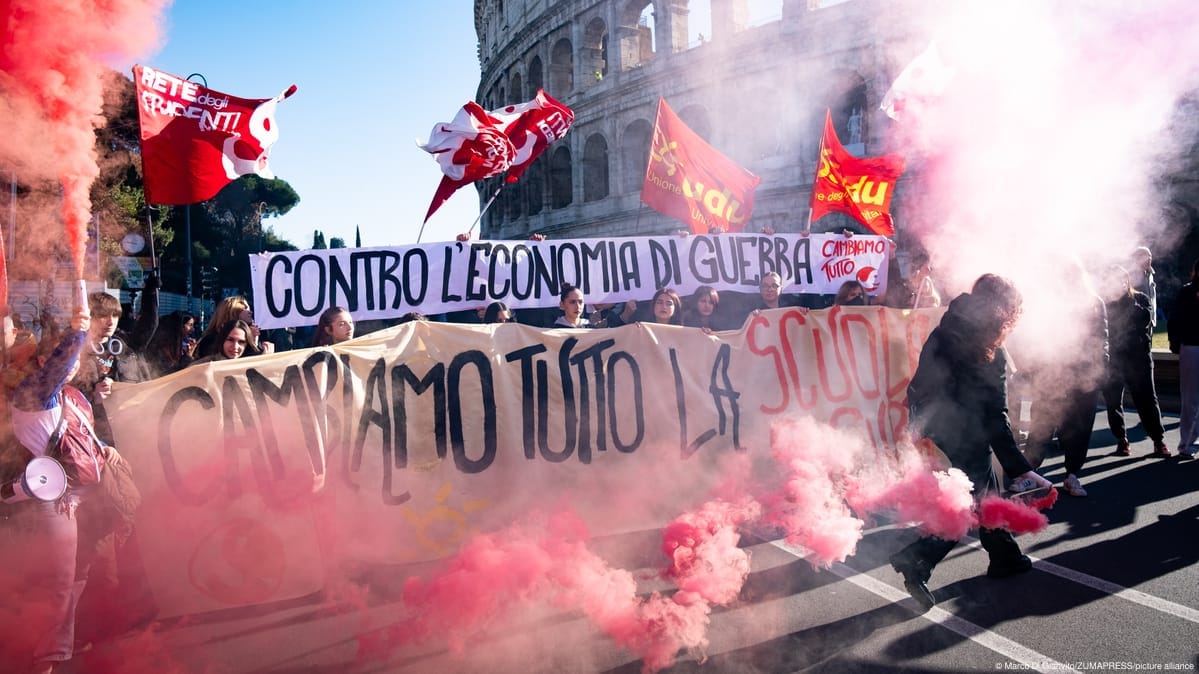
[Image Source: Protests in Tirana, Albania in June 2026, NurPhoto]