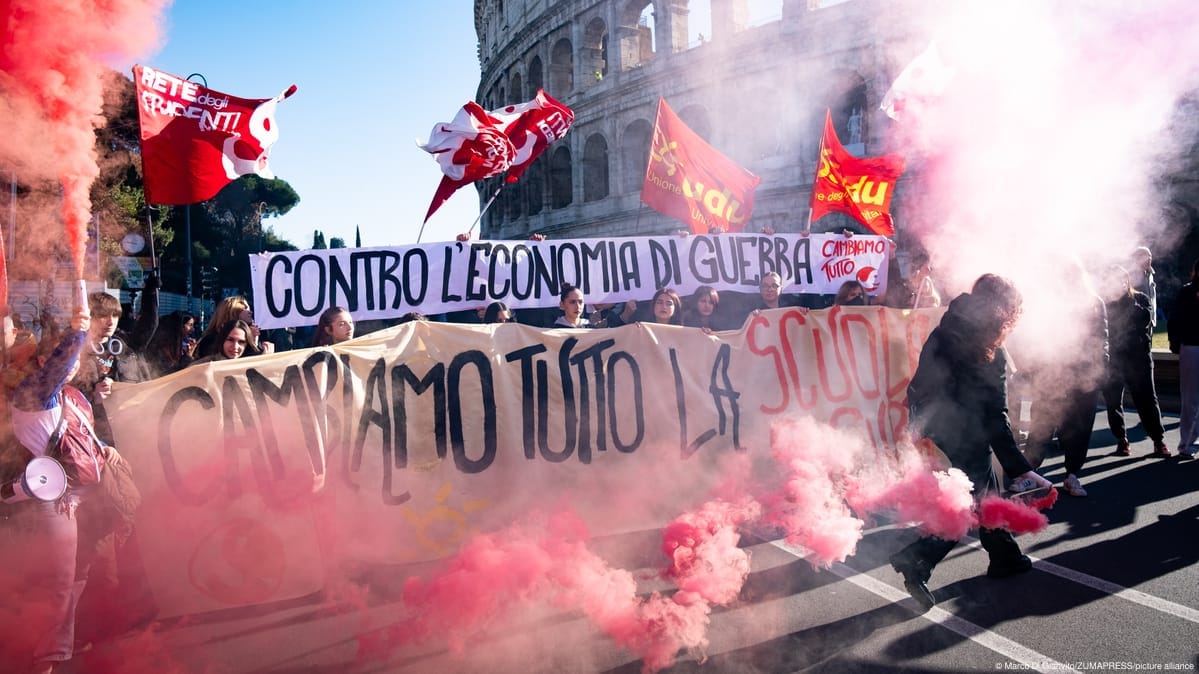
ITALY — On October 16, 400,000 people protested in 40 cities across Italy for “No Meloni Day.” Giorgia Meloni has been the prime minister of Italy since 2022, representing the fascist Brothers of Italy party. Protests continued the next day, with the announcement of protests to be held every week starting on October 17. The October 17 Movement has emerged, stating that it does not trust the government or its institutions and rejects the political parties that speak on its behalf and attempt to channel its discontentment into positions in government for themselves.
The root of the movement is the cost-of-living crisis ravaging Italy. This is particularly driven by fuel prices, which have increased by 26% since February. Since 2021, real wages have declined by 9.4%. From 2013 to 2025, military spending was increased by 90% and will increase further to 5% of GDP by 2035. At the same time, spending on social security, health services, and education has declined.
Since Meloni’s term began, the prison population has increased by 17%. The “DDL Sicurezza” law passed this summer introduced new crimes, expanded the applicability of some, and made punishments more severe. An organized blockade of a public road, previously punishable with a fine, can now be met with up to two years in prison for each participant. Protests inside prisons or migrant detention centers can now be punished with an additional eight years of imprisonment. Another provision of the act creates the crime of “illegal entry into the State,” nominally punishable with up to four years’ imprisonment; however, “it is also expected that the judge… orders the expulsion of the foreigner.”
The State has responded to protests with a sweeping wave of repression. 500 soldiers were brought into Milan, the “fashion and finance capital” of Italy, before the October 24 protests to protect the symbols of wealth in the city.
Since the protests began, hundreds have been detained, more than half of whom are minors, including at least one younger than twelve. 150 homes belonging to those suspected of participating in demonstrations have been raided; 51 of those suspected are minors. Surveillance drones have been deployed, and ID checks have been enforced to discourage protesting.
The imperialist State, by its nature, cannot solve the crises facing the masses, and it cannot let protests go on for fear of loss of capital. Its only response is to repress the movement through both overt and covert methods. The police are free to use water cannons and tear gas on peaceful demonstrations; the youth who then respond with stones, sticks, and fireworks can be punished with five years in prison and a 20,000-euro fine. Political parties, both “left” and right, are quick to condemn the violence of the youth. Minors aged fourteen to eighteen can be held in “administrative detention” even without being suspected of a crime.
The driving force behind the protests is not the youth randomly deciding to turn to violence: their anger is driven by the same global imperialist crisis which is driving protests spanning Europe. Everywhere, the youth realize that the real violence is not a few broken windows; it is that carried out by the imperialist system, which condemns billions to live in poverty, denying them a future.
[Image Source: Demonstrators in the streets oppose Meloni’s government, Marco Di Gianvito]