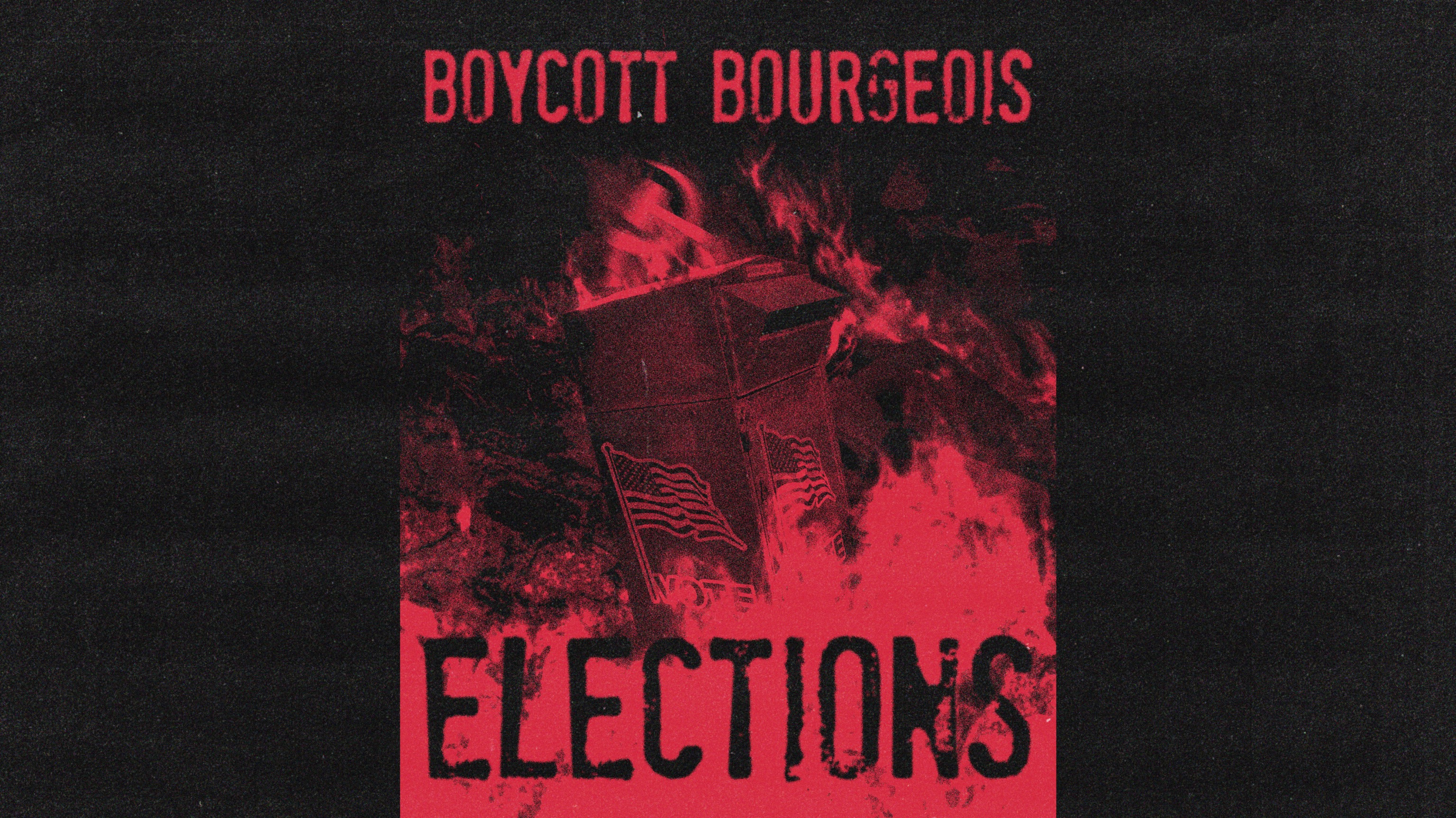
The Editorial Board of The Masses calls upon working and oppressed people to break with the parties of capitalist rule and take up the work of building independent class power. Unite in opposition to electoralism with the militant struggle against exploitation, national oppression, rising fascism, and U.S. Imperialism. Collectively organize workplaces, neighborhoods, schools, and every sector of popular struggle towards socialist revolution.
Class struggle has driven the history of U.S. bourgeois democracy. Its representative institutions developed alongside mass enslavement, Indigenous genocide, restricted citizenship and suffrage, and the ruthless defense of private property. The New Afrikan masses, alongside other enslaved peoples and oppressed nations, workers, and women, confronted these structures through prolonged struggle, forcing transformations upon an unwilling ruling order. Mass struggle destroyed legal chattel slavery, secured the limited democratic gains of Reconstruction, and won advances in labor rights and organization. Consequently, the ruling class fought to contain or reverse these gains without surrendering capitalist ownership or State power.
In the decades following Reconstruction’s overthrow, the incorporation of sections of organized labor into Democratic Party electoral coalitions increasingly tied demands for concessions to allegiance to the existing order. Roosevelt’s Social Fascist New Deal combined conditional relief and reform with the stabilization of capitalist rule, drawing working class organizations into dependence upon the State, promoting class collaboration, and containing revolutionary possibilities emerging from capitalist breakdown. The Civil Rights Movement and struggles of the 1960s later forced the destruction of legal segregation and expanded access to employment and housing. Bourgeois leaders worked tirelessly to convert those gains into electoral loyalty, subordinating demands for liberation to institutions that preserved capitalist exploitation and the coercive foundations of the bourgeois State.
Today, the masses continue to confront labor organized around profit, inaccessible social care, and rising militarization. Austerity, repression, and destitution are characteristic of everyday life for working and oppressed people. National oppression and patriarchy deepen that insecurity as migrant masses confront the capitalists and the State in the face of detention and deportation. New Afrikan, Chicano, Boricua, and Indigenous communities combat continuing dispossession, segregation, genocide, and State repression. Attacks on reproductive and gender affirming care tighten coercive control over women and queer people, sacrificing their health and bodily autonomy to reactionary despotism. Disabled people face institutional abandonment through the denial of essential services and barriers that exclude them from public life. Our response must unite struggles against these particular forms of oppression through a common movement against the capitalist-imperialist system reproducing them.
U.S. Imperialism enforces capitalist accumulation across borders through military aggression, sanctions, occupation, and extermination. It subordinates whole peoples to monopoly capital exploitation, plunders their labor and resources, and crushes their struggle for political independence. Militarization abroad strengthens the institutions, technologies, and methods of repression turned against the masses everywhere. Proletarian internationalism demands an uncompromising struggle against this imperialist system, uniting resistance to aggression abroad with independent revolutionary organization for the complete destruction of U.S. Imperialism from within.
Bourgeois elections organize competition over the personnel directing this order. They circulate officials, regulate succession, and negotiate contradictions among capitalist factions and their allies. Finance, industry, real estate, agri-business, military-surveillance complexes, and other interests seek different arrangements of taxation, regulation, labor discipline, repression, and public expenditure. Bourgeois parties assemble these interests into governing coalitions and incorporate popular demands on terms compatible with maintaining their rule. Electoral participation then supplies the procedure through which those coalitions claim authority to govern the whole population.
Formal political equality leaves workers and capitalists occupying radically different positions in social life. A capitalist can strip hundreds of workers of their livelihoods; a landlord can throw families into the street; a creditor can exploit illness, unemployment, and the struggle to keep children fed into destitution. Elections offer no corresponding transfer of these powers to the masses. The capitalist class exercises authority through the ordinary operation of property and labor relations, alongside lobbying, donations, and patronage. Electoralist movements focused on reform and tinkering within the system leave that authority intact. Election boycott confronts the foundations of this dependence by challenging the illusory base of capitalist-imperialist authority.
“The government’s convocation of a crudely faked “popular” representative body provides excellent opportunities for agitation for a truly popular representative body, for making the broadest masses of the people understand that at present…only a provisional revolutionary government can convene a truly representative body” –V.I. Lenin, The Boycott of the Bulygin Duma, and Insurrection
We call for casting away Constitutional Illusions: confidence that selecting different officials within the established machinery can substitute for transforming class power. Capital’s command over investment, employment, credit, and production continues beyond each election day. Courts enforce terroristic bourgeois laws, State agents execute our neighbors, and the bourgeois State continues its functioning regardless of the demands of the masses. Karl Marx said of this tactic in his work The Civil War in France: “The working class cannot simply lay hold of the ready-made state machinery, and wield it for its own purposes.” It must smash it!
Fascistization sharpens the urgency of our task. Executive concentration, militarized policing, surveillance, attacks upon collective organization, and the restriction of democratic rights strengthen the coercive authority of the capitalist State. The Trump government advances these tendencies through open reactionary terror and the targeting of designated internal enemies, such as through NSPM-7.
The Democratic Party offers the restoration of authority in capitalist institutions which are weaponized against the working and oppressed peoples. Its reform currents seek to renew that authority through promises to alleviate the suffering of the masses, while offering no fundamental change. The Social Fascist function of these politics lies in its incorporation of working class resistance into the preservation of bourgeois class dictatorship. The NGO complex, opportunist organizations, and State Union officialdom reinforce that incorporation through professional intermediaries, institutional funding, electoral mobilization, and the limiting of independent initiative.
People abstain from bourgeois elections through exclusion, exhaustion, distrust, or indifference, and those circumstances alone establish no common political program. An uncast ballot carries no automatic revolutionary meaning. “We must exert every effort to make the boycott of real use in extending and intensifying agitation, so that it shall not be reduced to mere passive abstention from voting.” –V.I. Lenin, The Boycott of the Bulygin Duma, and Insurrection
An active boycott works to transform dissatisfaction into conscious organization. The masses need housing, healthcare, and to combat oppression immediately. Reformism subordinates these struggles to the preservation of the capitalist-imperialist State. Revolutionary independent class struggle opens this terrain to the masses raising the banner for demands to the level of the political.
In the workplaces, committees and unions capable of gathering grievances, formulating demands, confronting State terror, and organizing collective action must flourish through the struggle against exploitation and for improved conditions, dependable hours, and freedom from discrimination and retaliation. Workers must build independent class conscious organizations to enact militant collective action, asserting their own political leadership against the State Union bureaucracy, and refuse to confine class struggle to bourgeois courts, electoral campaigns, or negotiations managed by officials enforcing class collaboration.
Wherever the masses live, build tenant committees and unions against rents, neglected housing, deteriorating conditions, displacement, landlords, and evictions. Organize against cuts to education, transportation, healthcare, and public services. Develop neighborhood organization as part of the durable struggle at the points of social reproduction to replace the systems of the bourgeois State.
Neighborhood Defense Units and other rapid response forces must document, track, confront, and resist deportation raids, police terror, militarization, and surveillance. These forces must also defend and support the detained, their families, and their struggle against the courts. Convene assemblies of the masses and link neighborhood defense with tenant and workplace committees.
Uphold the right of oppressed nations to determine their own future. Connect the struggles of Indigenous peoples, New Afrikans, Chicanos, and Boricuas with the revolutionary movement against exploitation and imperialist domination. Build solidarity across language and national origin and confront chauvinism of all types within and without our organizations. Develop women’s and queer liberation, migrant defense, and student organization as integral fronts of class struggle. Demand an end to the Zionist Entity and stand with Palestinians and all peoples resisting genocide, occupation, and dispossession.
Defend political prisoners and people facing political prosecution. Support the defense campaigns of the Michigan 12, GSU-RSU, Minnesota 15, Prairieland Defendants, and Communist League of Uganda, alongside comrades Kevin “Rashid” Johnson, Shaka Adiyia Shakur, Mumia Abu-Jamal, and Reverend Joy Powell. Organize correspondence, court attendance, and public campaigns demanding their freedom!
Join and build the organizations through which work on all fronts can develop: New Labor Organizing Committee, People’s Defense Committee, Revolutionary Student Union, Corriente Popular Damián García, Meidoutong, Jal-Jangal-Jameen, and Borikén Liberation Front. Intensify labor organizing with Gig Worker, New Day at UPS, New Day at Amazon, New Day at USPS, and Organization of Class-conscious Service Workers.
Build the Revolutionary Front through workplace papers, neighborhood organization, public demonstrations, mass culture, and political education. Read, send reports, and contribute to The Masses, New Labor Press, The Partisan, The Crusader, and La Obrera.
Organize for revolution, collective ownership of production, socialist planning, and a society governed by the masses! Deepen the struggle against exploitation, national oppression, rising fascism, and U.S. Imperialism, and develop the independent forces through which the masses can transform the world!
Cast Away Constitutional Illusions!
Boycott Elections, Build the Movement!
Defend the Masses! Deepen the Struggle!