The Masses Editorial Board is republishing this article from the Brazilian revolutionary newspaper A Nova Democracia, translated into English for our readers. For more than 20 years, A Nova Democracia has reported on the struggles of workers, peasants, Indigenous peoples, and other oppressed sectors in Brazil and internationally, while advancing a “democratic, popular, national, and anti-imperialist” line in opposition to the Brazilian Old State.
The Masses Editorial Board is republishing this piece as the Trump regime’s expanding border wall demonstrates how the anti-immigrant offensive of the U.S. is bound together with the continuing dispossession of Indigenous peoples, destruction of culturally significant land, and attacks on the natural environment. The article documents the threat to thousands of archaeological sites along the Rio Grande, the suspension of preservation laws, and the resistance being organized by Indigenous communities, landowners, researchers, and other local people.
A Nova Democracia can be read in Portuguese at anovademocracia.com.br.
The Rio Grande, in the United States (USA), is a channel of brilliant blue water whose banks are dominated by shrubs such as buttercup bush, sarandi and granjeiro, by grasses such as false grass, and by large trees like the willow and the Texas ebony. Thirteen thousand years ago, Indigenous peoples of the Americas lived there and left traces that are studied today by archaeologists. Now, professionals and Indigenous peoples are racing against time to save these sites amid construction of Donald Trump’s new anti-immigration wall, which is meant to run across the entire region.
“Border barrier construction is happening in several stages at various locations along the Rio Grande, throughout Texas,” archaeologist Amanda Castaneda, of the Shumla Archaeological Research and Education Center, told our reporter.
The archaeological record consists of things like rock art and artifacts that are hard to preserve, such as woven baskets and sandals and tools made of wood, which have survived there exceptionally well thanks to the very arid environment of the desert surrounding the river.
The destruction begins roughly at El Paso, from Fort Hancock to Big Bend Ranch State Park, with the construction of a 9.1-meter (m) wall. “On the east side of the State Park and throughout Big Bend National Park, there will be a combination of vehicle barrier and ‘new technology and patrolling,’” Castaneda adds.
Another “vehicle barrier” of roughly 1.5 m, along with patrol roads and support systems, will be installed downriver in Big Bend National Park. “Our focus area is included in this project, mainly in Val Verde County,” the archaeologist concludes.
More than 2,500 rock art sites
The archaeological sites are scattered across the whole region. “The archaeological sites include open-air camps on the uplands and river terraces, as well as habitation sites in rockshelters that show excellent preservation of cultural material,” Castaneda explains.
In total, there are around 2,500 archaeological sites already recorded around the confluence of the Pecos and Devils rivers with the Rio Grande. In Val Verde County alone there are 350 rockshelters with animal figures, humanoids, geometric forms and hunting implements painted in red, blue and yellow or carved into the stone.

“The region’s best-known style, the Pecos River style, is a complex polychrome muralist tradition containing records of cosmology, creation, religious mythology, deities and ancestors,” Castaneda reports.
“Val Verde’s cultural history is so significant that in 2021 the area was declared an archaeological district of national historic importance,” the archaeologist says. That designation, however, is not enough to stop Trump. The project threatens to destroy, or block access to, a third of the archaeological areas.
Access to land
The rock art sites help us better understand the region’s Indigenous history and recognize peoples’ right of access to the land. “There are many present-day Indigenous groups with a long history in what is now Texas, but which have no federal recognition and no reservations, as other groups across the country do,” Castaneda explains.
Researchers at the Shumla Archaeological Research and Education Center are working to increase the interaction of the region’s Indigenous peoples with the archaeological sites. The Comanche, Lipan Apache and Jumano groups, and various others grouped under the name “Coahuiltecan,” have important ties to the rock art record; the Coahuiltecan are more closely linked to the ancient art, while the others connect to more recent records.

In addition, Dr. Carolyn Boyd has demonstrated that the symbolism of the Pecos River rock art style is present in the beliefs of the Huichol (or Wixárika), who live in southwestern Mexico, and in the mythologies of Uto-Aztecan-speaking peoples. She recently traveled to meet Huichol elders in Mexico. The archaeologists also managed to bring a leader of the group to visit archaeological sites in the region.
The fight for preservation
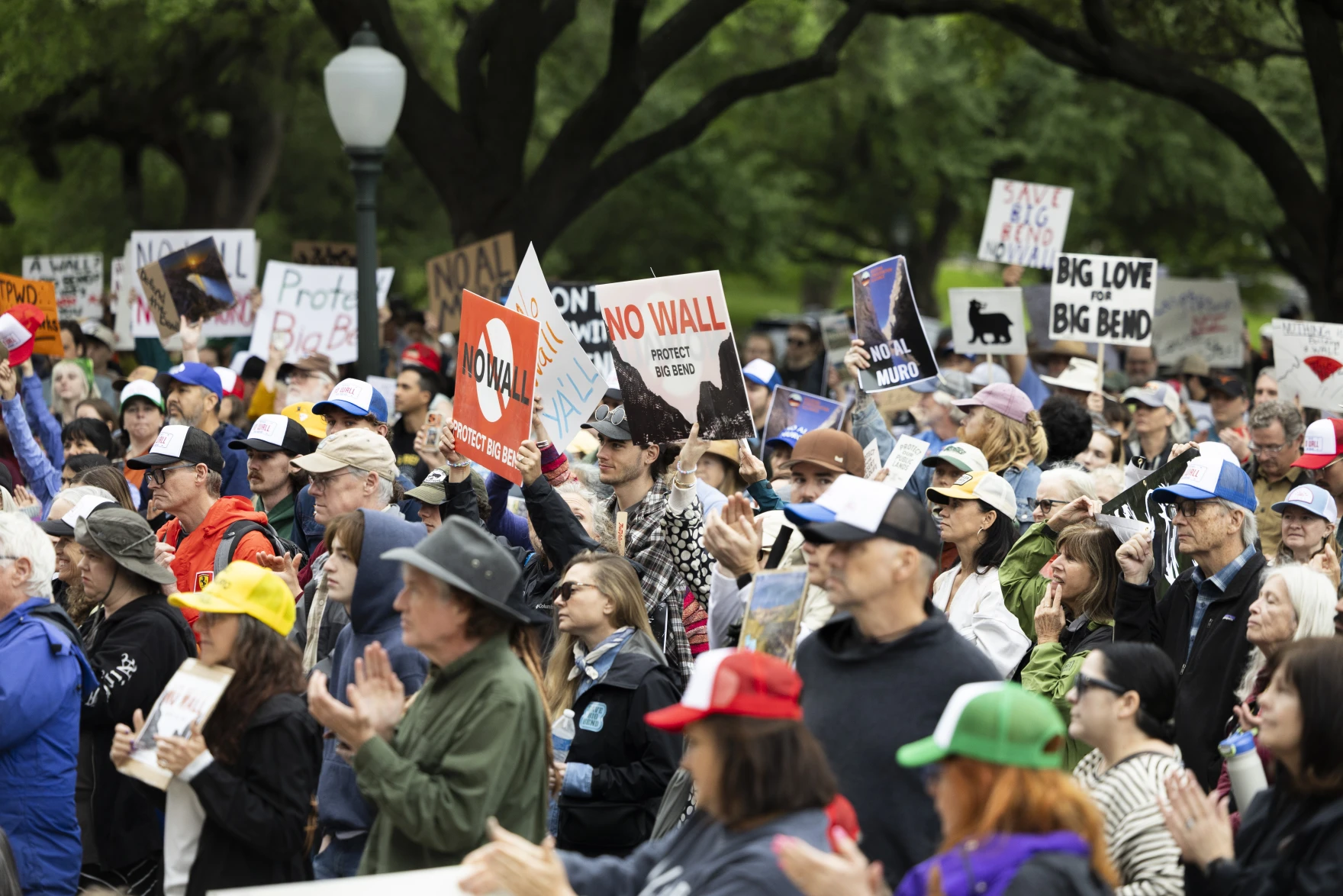
“There are many groups following this situation, and the most active of them is a grassroots movement called ‘No Big Bend Wall,’” says Castaneda. Information about the group can be found here.
Members of No Big Bend Wall act as on-the-ground observers, recording all information on the advance of construction in Big Bend National Park and making it available in charts on the Internet.
At the same time, they are forming a coalition of local landowners, through which they provide legal counsel and communications support in the face of threats from the construction. “This situation has brought together people of all kinds across west Texas to fight for shared values of conservation and protection of this special landscape,” Castaneda says.
The archaeologists, for their part, assist residents and Indigenous peoples however they can and are working on documenting the rock art records, aiming to create a large digital archive.
The people know that if the project goes through, nothing good will come of it. In Arizona, mountainsides were destroyed by blasting, animal migration corridors were cut off and cultural sites were destroyed; at Intaglio, part of the construction destroyed an entire half of an archaeological site.
Other work carried out between 2017 and 2021 on the US–Mexico border blew up an Indigenous burial area and caused changes to watercourses, among various other acts of degradation of natural resources and sites of cultural importance, according to 2023 data from the Government Accountability Office (GAO), an oversight body of the Yankee Congress itself. At the time, the government installed 730 km of barriers.
The destruction was only possible through repeated non-compliance with environmental and historic preservation laws. Recently, a waiver signed in February 2026 allowed 28 laws to be set aside, among them the National Historic Preservation Act, the Archaeological Resources Protection Act, the Native American Graves Protection and Repatriation Act, and laws protecting water, air and endangered species. A new waiver, signed in June, reached even the rules protecting national parks and wilderness areas.
What is happening in Texas is, therefore and once again, the struggle of the interests of the imperialists against the interests of the people, who carry within themselves the progressive cause of humanity. The No Big Bend Wall coalition has identified around 330 affected property owners along a single 281.6 km stretch; dozens of them have begun receiving information and support from the movement in order to confront attempts to acquire or expropriate their land.
The resistance is drawing lessons from other struggles that have already taken place there. During Trump’s first administration, resistance in west Texas managed to delay the project to build a large wall on the border. In the south of the same state, resistance from residents, disputes over the route and expropriation proceedings meant that land acquisition for the wall took 21 to 30 months — against roughly 12 months in other regions.
At Big Bend, a petition against the wall in the region surpassed 100,000 signatures in April of this year. On August 14, the Indigenous organization People of La Junta for Preservation, tied to the Lipan Apache community, went to court to halt the construction in Big Bend National Park, alleging irreparable threat to archaeological sites and traditional places. Three days later, after images circulated of excavators breaking ground in the park and protests grew, the Border Patrol itself announced a temporary suspension of construction activities inside Big Bend in order to reassess the project.
The occupation is important and points to another lesson: that popular struggle in defense of science and natural resources can be greatly strengthened by uniting with other popular groups. This can be intensified through contact with the vast array of anti-imperialist and immigrant movements that fight tirelessly against the wall and other attacks by the imperialist US government.
Everything depends, then, on the course of the popular struggle, determined by the choices of its immediate soldiers in the arena of the class struggle.