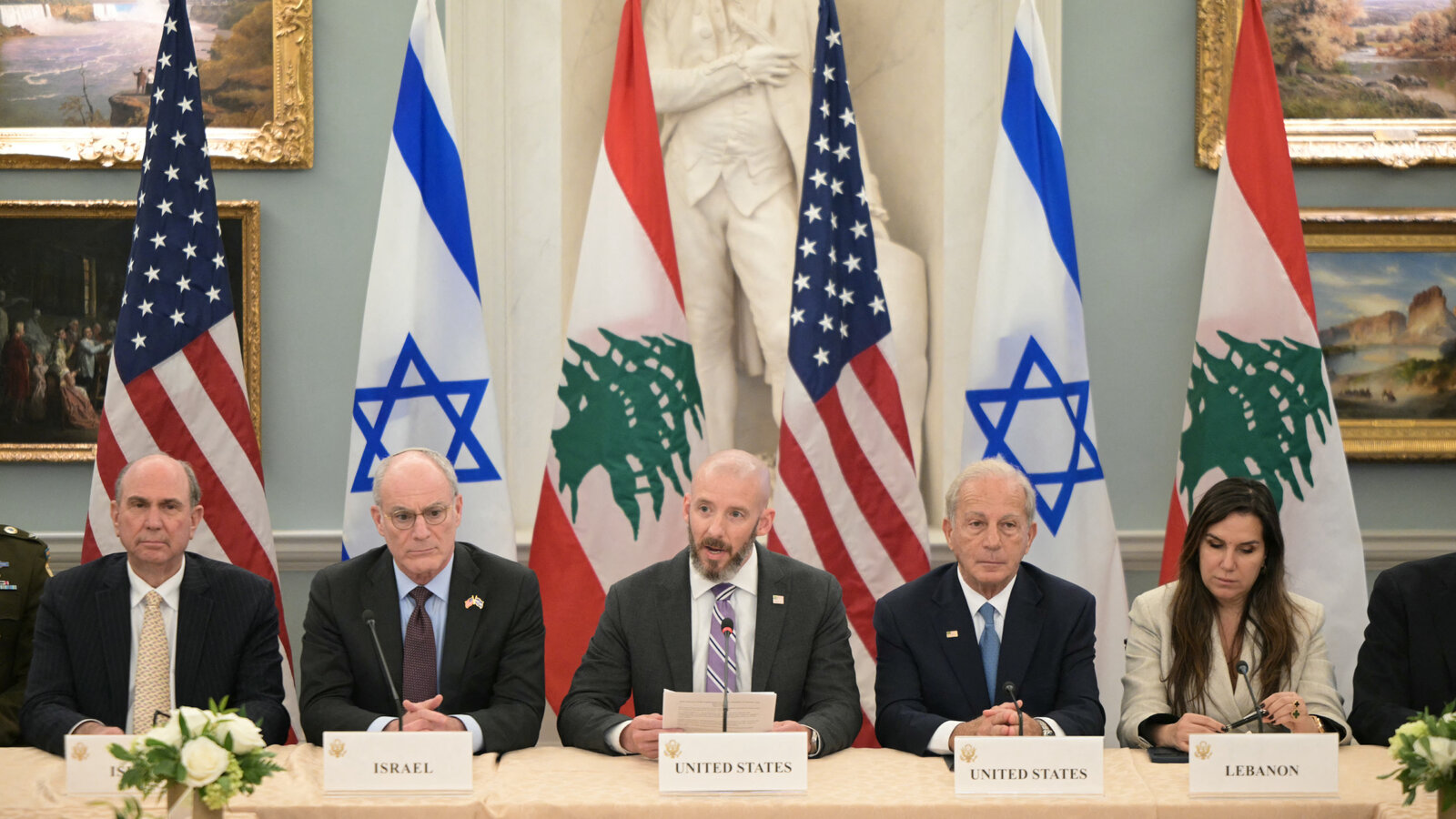
BEIRUT, Lebanon – The framework agreement signed by Lebanon and “Israel” in Washington on June 26 was sold as the end of the latest war. Nearly a month later, “Israeli” forces remain dug into southern Lebanese territory, continue to carry out strikes and demolitions, and have given no binding date for withdrawal. The deal, brokered and signed in the U.S. capital, reorganizes the occupation, locking Lebanon further into Washington’s regional order against Iran.
The war began with U.S. Imperialism, when the United States and “Israel” assassinated Iran’s Supreme Leader, Ayatollah Ali Khamenei. In retaliation, Hezbollah fired rockets into northern “Israel” on March 2. “Israel” seized on the token volley to activate a blueprint for war against Lebanon prepared long in advance. The bombardment and ground invasion that followed leveled entire villages across southern Lebanon, Beirut’s southern suburbs, and the Beka’a Valley. Since March, 4,328 Lebanese have been killed and over a million displaced, according to Lebanon’s Ministry of Public Health, with more than 12,000 wounded. At least 32 “Israeli” soldiers and four “Israeli” settlers have been killed in the same period.
The June 26 framework ties any “Israeli” withdrawal to the “verifiable” disarmament of Hezbollah. On July 20, the State Department named three “pilot zone” villages, Froun, Srifa and Zawtar al-Gharbiya, as the first areas slated for a phased handover to the Lebanese army. Days later, the mayors of two of the three villages told reporters nothing had changed on the ground and “Israeli” forces had not withdrawn. The agreement sets no timeline for a full “Israeli” exit from the roughly one-fifth of Lebanese territory it occupies. “Israeli” officials have said they intend to hold a “security zone” 10 kilometers inside Lebanon for as long as Hezbollah remains armed. War criminal Benjamin Netanyahu has boasted that “Israeli” forces “will not leave” and that they “dominate southern Lebanon.”
Clauses 3 and 13 of the deal are designed to shield “Israel” from accountability, blocking recourse to the International Criminal Court and International Court of Justice and conditioning the return of displaced residents on Hezbollah’s disarmament rather than the end of hostilities. Lebanon’s Deputy Prime Minister Tarek Mitri has since acknowledged the framework has not been approved by the Council of Ministers and is not a binding agreement, calling it merely “a beginning.”
“Israeli” forces have carried out attacks on civilians, indiscriminate strikes, and the use of white phosphorus over residential areas throughout the war. More than 11,000 buildings in southern Lebanon have been completely destroyed by “Israeli” forces.
“Israeli” forces struck Beit al-Sayyad with artillery in July, while troops in Hadatha demolished and burned homes with explosives and bulldozers. None of this has been reined in by the “ceasefire.” Two days after the framework’s signing, IDF Chief of Staff Eyal Zamir approved further military operations “in accordance” with it, and “Israel” has continued operating from outposts inside Lebanese territory ever since.
Hezbollah leader Naim Qassem rejected the deal as “null and void.” He insisted that “no political solution could succeed without a complete Israeli withdrawal,” and that resistance will continue “until liberation of Lebanese land.”
The deal emerged from Lebanese President Joseph Aoun’s visit to the White House, part of a broader U.S.-Saudi strategy to strip Iran of influence across Lebanon, Syria and Iraq. It came one week after Iraq’s new prime minister agreed with Washington on a September deadline to disarm pro-Iranian militias there.
The framework exposed the comprador character of Lebanon’s ruling elite in stark terms. The Lebanese officials who signed it are not sovereign statesmen protecting their country, but collaborators who sold out their population to Washington and Tel Aviv. Former Prime Minister Fouad Siniora, representing Lebanon’s own financial elite, admitted the country was “forced to deal with the Americans,” warning that rejecting the deal would only bring “something even more bitter.” It was a naked confession: Lebanon’s comprador bourgeoisie, whose fortunes rest on channeling foreign capital rather than building independent national industry, would rather sell out the resistance than face its own bankruptcy without U.S. patronage.
The pattern extends well beyond Lebanon. “Israeli” forces and settlers have continued raids across the West Bank throughout the same period, demolishing homes and schools, displacing hundreds more Palestinians, while advancing plans for tens of thousands of new settlement housing units. The ceasefire architecture assembled by Washington manages the pace of “Israeli” expansion rather than restraining it, securing Washington’s larger campaign against Iran in the process.
The framework is nothing but the imperialist reorganization of Lebanon’s subjugation, dressed in the language of sovereignty and stability, negotiated over the heads of the Lebanese masses and enforced against them by their own collaborationist state. Genuine liberation for Lebanon, as for Palestine, will not come from Washington’s frameworks or from a comprador bourgeoisie that has already shown its readiness to sell out the resistance for loans and reconstruction funds. Only through the armed and organized resistance of the Lebanese people, uniting the working class and oppressed peoples of the region against U.S. Imperialism and Zionism, can genuine liberation be won, as part of the wider fight to smash the imperialist world order.