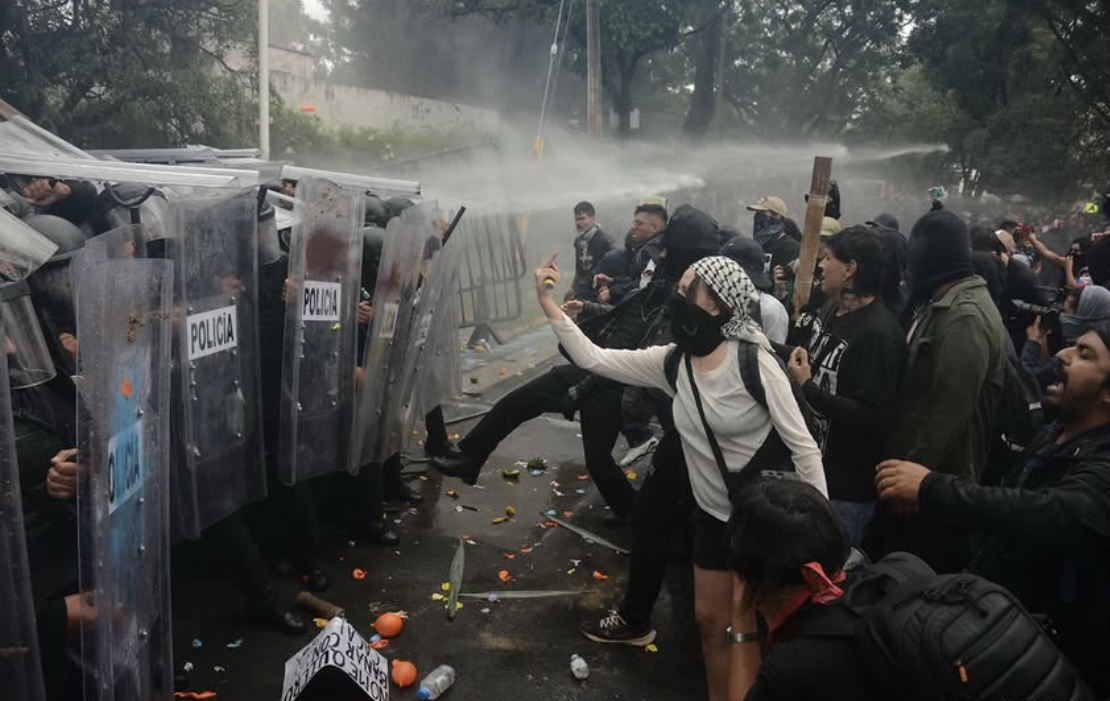
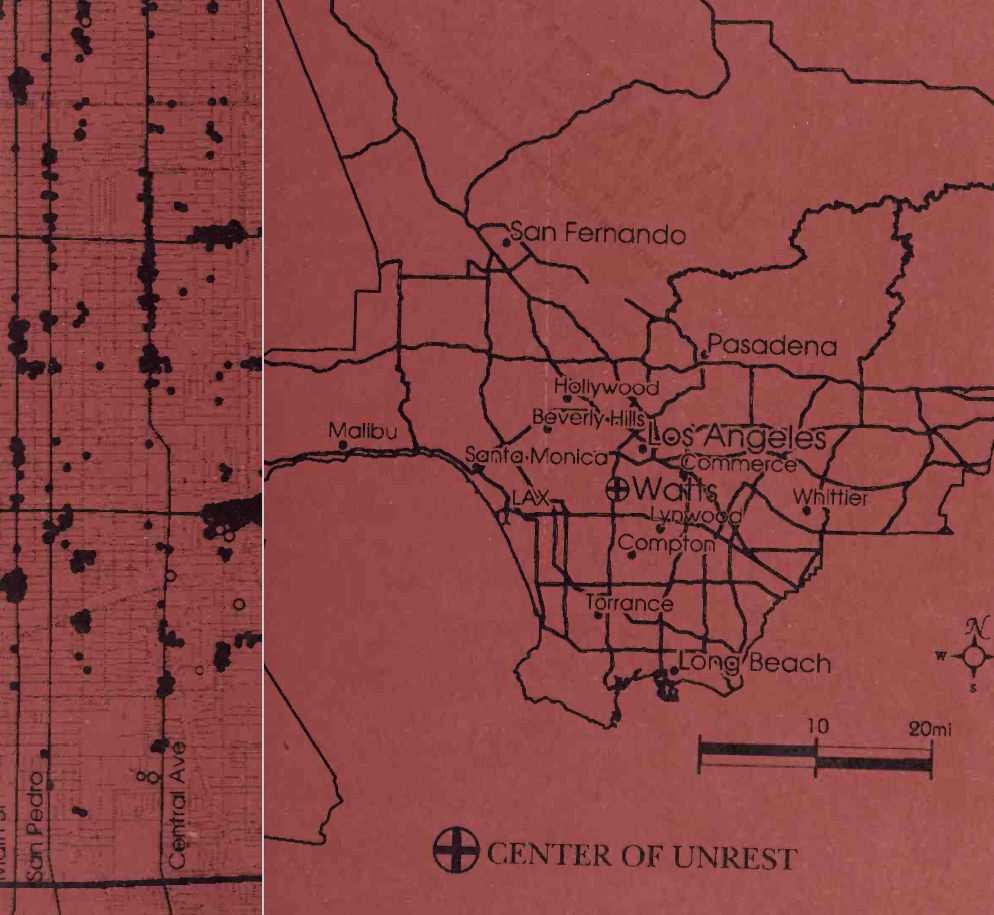
LOS ANGELES – August 11, 1965, was a watershed moment in the history of the contemporary struggle of New Afrikan people against the Old State. No mass rebellion of the New Afrikan proletariat and urban poor generated more devastation toward the ruling class and exposed the bankruptcy of the Old society more than the Watts Rebellion in Los Angeles, California. A year after the ratification of the Civil Rights Act, the New Afrikan masses of the Watts neighborhood launched a full-scale spontaneous attack on private property in response to the long history of brutality by the Los Angeles Police Department and state agencies. For six straight days, New Afrikan proletarians destroyed multiple businesses run by the upper petite and imperialist bourgeoisie, bringing about a total of $200 million ($2.1 billion in 2026) in property damage.
The massive response toward the very act of police brutality that triggered the uprisings did not occur overnight; it was the result of the social conditions in the city that facilitated the exploitation and oppression of the New Afrikan national minority outside of the Black Belt. In the 1940s, Watts, a neighborhood in South Los Angeles, became predominately New Afrikan by way of World War II and the Second Great Migration, bringing multiple thousands of migrants from the Southeast, including Mississippi, Louisiana, Arkansas and Texas. As many came and worked in large-scale heavy industry, the city built many housing projects for the newly arrived national minority in the neighborhood. Two-thirds of New Afrikan adult residents never completed high school, and 1 in 8 could not read.
However, as many came, many also left; white flight had gradually taken precedence, and the European-American residents began to move to the bourgeois suburbs of Los Angeles. At this time, the imperialist bourgeoisie was becoming unpopular and bankrupt, so it began to sabotage itself by firing workers and disappearing large-scale social production en masse across the United States; in Watts, this move toward cheaper labor in the oppressed nations created a large and impoverished New Afrikan reserve army of labor totaling nearly 35,000 to 40,000 people. In addition, the means of transportation for New Afrikan proletarians was severed when the Long Beach Line discontinued in 1961, worsening social conditions for the national minority.
This internal powder keg was further exacerbated by racist violence and terrorism against New Afrikan-majority Watts at the hands of the notorious Los Angeles Police Department and large-scale privatization of public services affecting New Afrikan residents, including education and medical care. New Afrikan youth were heavily policed and always left at the mercy of the Old State. At the same time, the Civil Rights Movement was at its end, concluding with the passing of legislative acts masqueraded by petite bourgeois forces as short-term gains, including the Civil Rights and Voting Rights Acts. Under then-President Lyndon B. Johnson, the latter was passed on August 6, 1965, promising protections against racial discrimination in voting. However, the contradictions between the New Afrikan proletariat and urban poor and the agencies of the Old State reached a boiling point five days later, and exposed the ultimate failures of the Second Reconstruction in an inferno of struggle.
Around 7 p.m., New Afrikan youths Marquette and Ronald Frye were driving their mother’s car near the corner of Avalon Boulevard and 116th Street when they were pulled over by a white State Highway Patrol officer. Criminalized, Marquette was arrested and quickly grew furious. He began to fight one of the accompanying officers, and Ronald joined in, both to resist the police and to protect his brother. Gradually, New Afrikan residents began to gather around the scene, intensifying police violence; Ronald was jabbed in the stomach by a newly arrived officer’s riot baton, and Marquette was then struck as well and arbitrarily arrested. Their mother, Rena Frye, arrived on the scene and witnessed her sons being abused by the police, quickly acting to defend them. Rena was forcibly arrested as well; Ronald rushed to defend her and was handcuffed again. By this point, the New Afrikan masses had become restless and enraged. More highway patrol arrived on the scene, using batons and guns to control the crowd, drawing hundreds more Watts residents into the situation. One police officer on a motorcycle was then spat on, and they immediately began searching for a New Afrikan woman they thought was to blame. Joyce Ann Gaines, who was believed to be pregnant at the time, was found and dragged out of the crowd. By 7:45 p.m., the anger and misery of oppression and impoverishment, stoked by the broken promises of revitalization under bourgeois democracy, exploded among the masses present.
The next day, on August 12, the Fryes were released on bail. A subsequent community meeting hosted by bourgeois politicians and New Afrikan establishment figureheads was held, becoming a platform for Watts residents to express their resentment towards the police and government. Although Rena Frye implored the crowd to calm down, it did nothing to stop the upswing of spontaneous struggle unleashed for the next five days. That same day, a similar mass uprising was taken up by the proletarian New Afrikan masses in Chicago’s Garfield Park neighborhood on the West Side for three days, following the death of New Afrikan youth Dessie May Williams at the hands of negligent firefighters.
By the end of the rebellion on August 16, 34 people were dead, 4,000 were arrested and 1,000 were injured. 16,000 enforcers of the Old State, from the LAPD to the National Guard, were called in to suppress the mass uprising in Watts. 261 buildings were completely destroyed, and another 600 were damaged, all of which were owned by the ruling class. Despite the immense devastation faced by the propertied classes, the liquidation of the multinational proletariat’s political leadership by way of the internal destruction of the Communist Party of the USA and subsequent McCarthyite repression left Watts with little to no class leadership to form concrete long-term struggle in the neighborhood. Instead, the growing political-ideological influence of the New Afrikan petite bourgeoisie and leadership of the New Left, including the Black Panther Party, promoted non-proletarian political lines and approaches to serving the New Afrikan masses, including cultural nationalism, reformism and Left opportunism, a trajectory Gerald Horne traces at length in his history of the uprising and its aftermath. In the coming years, as class disparities worsened, the working and living conditions of the New Afrikan national minority followed suit, as is still faced today.
The massive losses of the owning classes at the hands of the New Afrikan masses of Watts formed a line of delineation between those who had nothing to lose and those who thrived on class collaboration, assimilation and accommodation. The six-day uprising serves as a stark reminder of the Old State’s inherent doom, but also as an important lesson in wielding strong class leadership among the lowest and deepest masses in the United States, most especially the New Afrikan proletariat and poor.
As the Old State furthers its terrorism on New Afrikan youth and migrants during fascistization today, the necessity to chiefly organize the poorest of the masses is non-negotiable in order to build the New State and establish Socialism, for it is the oppressed masses who endure the absolute worst at the hands of the imperialist bourgeoisie who are capable of building People’s Assemblies to govern their lives; only through proletarian leadership can poor and working New Afrikans reclaim their destiny in the neighborhoods we inhabit and the social production we produce value in.
As Chairman Gonzalo plainly reminds, the poorest masses, who constitute the majority, are “those most disposed to rebel, who clamor the most to organize the rebellion.” As shown by the Watts Rebellion of 1965, the New Afrikan poor have nothing to lose, and the oppressed hold every right to rise in defense of their neighbors and communities against the terrorism of the Old State, and to build upon its ashes the New society, governed by the proletariat.