The Masses Editorial Board received the following piece on July 4, 2026, the date marking celebrations of the 250th anniversary of the establishment of the United States of America on Indigenous land.
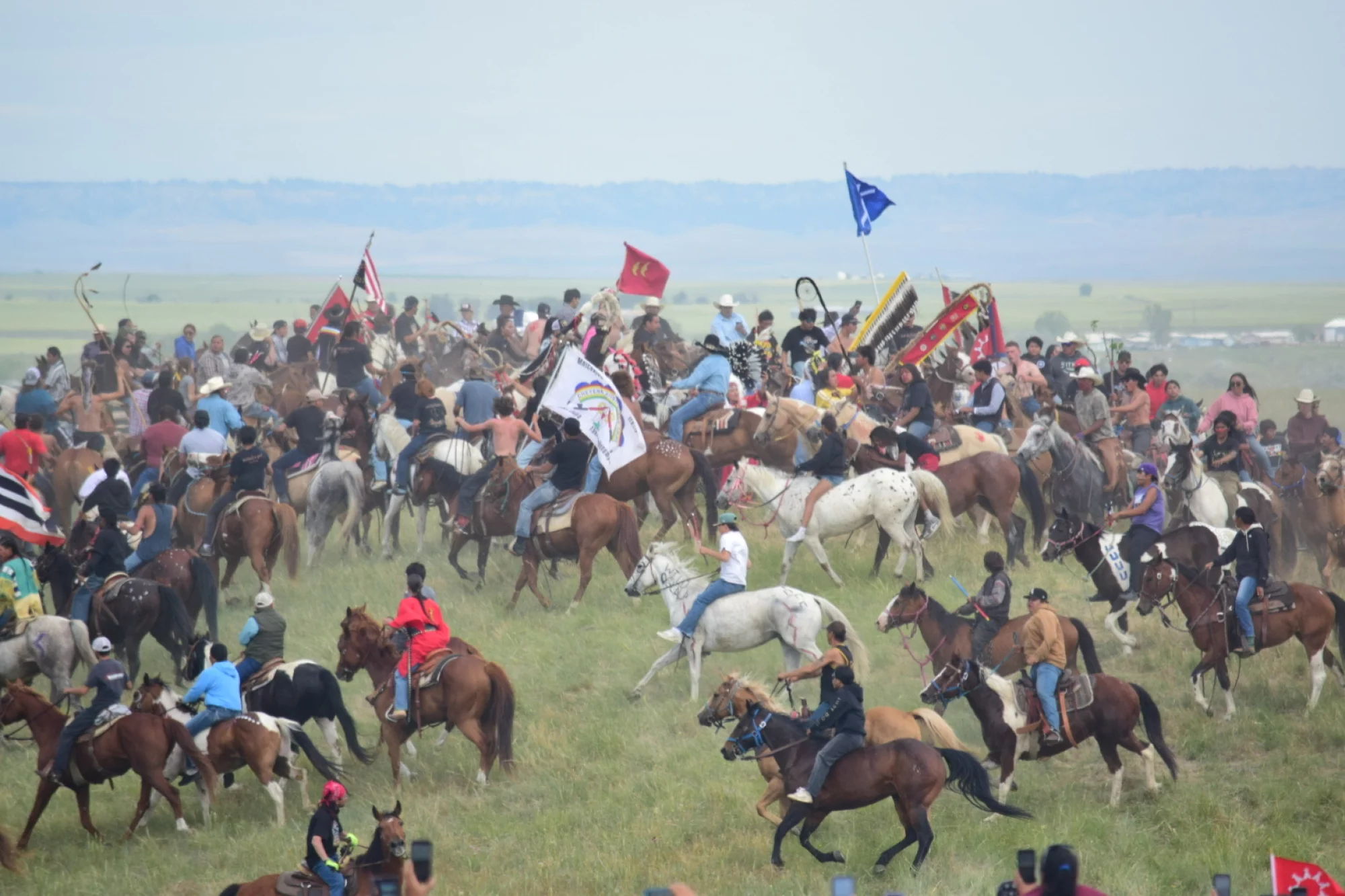
CROW AGENCY, MONTANA – On June 25, members and descendants of over 20 Indigenous nations across the continent gathered on the rolling plains along the Little Bighorn River to commemorate the 150th anniversary of the two days of armed resistance that secured the Dakota, Lakota, Northern Cheyenne and Arapaho nations victory against the armed forces of the Old State.
Celebrated as the Battle of the Greasy Grass by the Lakota people, the two-day conflict on June 25 to 26, 1876, was the resistance of Indigenous peoples against the U.S. bourgeoisie’s efforts of westward expansion and colonial conquest of ancestral lands; contradictions between the Indigenous nations and the class enemy reached boiling point when the big bourgeoisie violated the 1868 Black Hills Treaty after discovering gold reserves in the Black Hills in 1874. Determined to defend themselves, their lands and ways of life, the aforementioned nations waged armed struggle against the 7th Calvary Regiment of the U.S. Army. Lt. Col. George Armstrong Custer, leader of the regiment, planned a military attack against the Great Plains nations in his quest to become president and suppress them for more land; however, the Indigenous peoples along Little Bighorn River were able to overwhelm and crush Custer and his 200 henchmen entirely, marking one of the first times the Old State suffered defeat in the hands of the oppressed.
Horse-mounted riders, along with women and children, arrived at the site of the rebellion to celebrate. The youth masses of the Great Plains nations, with their vitality and determination to learn their own history, packed the celebrations. Youth councils, school groups and children played games with traditional sticks, cooked, set up tipis, and guided elders.
The week’s worth of festivities to commemorate the rebellion included free admission to the National Memorial of the Greasy Grass battle June 25-27th, an annual re-enactment event from the 26 to 28, and an All Nations 150th Anniversary celebration from the 24 to 27 attended by various Lakota, Cheyenne, and Arapaho peoples.
Custer, an enemy of the people, is memorialized by the Old State as a hero, even a progressive; they purport his learning to speak Arikara, Lakota and sign languages of the Great Plains nations. The reality is, he attempted to carry out said military attack with the intent of displacing the Indigenous peoples of the Great Plains into reservations, and the local tribes were determined to defend their existence by any means necessary. Lakota warriors such as Crazy Horse and Sitting Bull gathered the masses to fight the class enemy until victory, shaping the legacy of resistance of Indigenous peoples since the formation of the Old State.
However, the U.S. big bourgeoisie, then imperialist in embryo, fought relentlessly to suppress and crush Indigenous resistance once and for all. In 1877, Crazy Horse was martyred, and in 1890, Sitting Bull and 12 others were killed by federal police agents. The enemy subsequently brought misery, starvation, and forced surrender to the Great Plains peoples in order to make them pay for their victory against the Old State; in 1879, the first off-reservation federal Indian Boarding School opened in Carlisle, Pennsylvania, followed by hundreds more to forcibly assimilate and conquer Native peoples.
Since the beginning of colonial conquest and dispossession by the U.S. bourgeoisie, Indigenous peoples and nations never stopped fighting for self-determination and reclamation of their lands, histories, cultures, languages, and traditions. The Greasy Grass rebellion serves as a defining moment in the tradition of struggle and resistance by oppressed peoples in the U.S., particularly the original inhabitants of the land for 20,000 years, proving that the Old State is not invincible and will be crushed by the strength and power of the masses. The proletariat and Indigenous peoples within the U.S. Old State must unite and struggle together, unwaveringly, against the ruling class’s land theft, cultural oppression, and linguistic suppression, for it can only be through the building of a New Society led by the proletariat that Indigenous peoples and nations can truly realize their emancipation from national oppression by monopoly Capital.
Following the examples of the people’s struggles in India, Peru and the Philippines, the proletarian and national liberation struggles are lifeless without each other; Indigenous peoples, under monopoly bourgeois dictatorship, have been forced to rescind their ancestral lands and live in segregated concentration camps and working-class neighborhoods in decay. the determination and organization of Indigenous peoples to crush the reactionary Old State through proletarian leadership in the struggle for land is a non-negotiable task for the multi-national working class in the urban and rural neighborhoods, reservations, and sacred lands we live, work and struggle in.