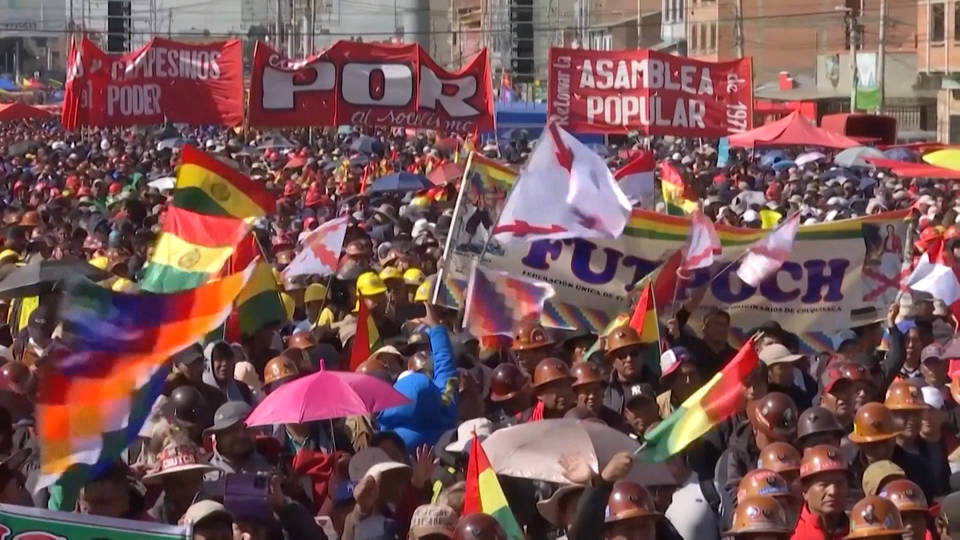
LA PAZ — Mass demonstrations and protests in Bolivia have now continued for more than 50 days, as a coalition of workers, farmers, and indigenous peoples protest austerity measures imposed by the right-wing president. In the current phase of unrest, protesters are demanding the government to resign, as well as reforms to address the economic crisis that has aggrieved the masses of Bolivia since late 2024.
The current president of Bolivia, Rodrigo Paz, is a right-wing populist of the Christian Democratic Party who ran on a campaign of “capitalism for all”, claiming that he would address the economic issues in Bolivia, including commodity shortages and an inflation rate of nearly 20%. During the election, Paz portrayed himself as a moderate alternative to his more openly reactionary opponent, the former president Jorge Quiroga.
After winning the election in a runoff and taking office in November of last year, Paz’s cabinet appointments did not include representatives of the trade union and indigenous movements, unlike previous governments. Paz quickly undertook his reactionary, pro-capitalist agenda, with his first action in office being the abolition of the tax on large fortunes.
At the end of last year, Supreme Decree 5503 was issued by the president, declaring a “State of Economic, Financial, Energy and Social Emergency” throughout the nation. Part of the Decree was the cancelling of fuel subsidies that had been in place for more than 20 years, leading to an 86% increase in the price of gasoline and a 162% increase in the price of diesel fuel. The Bolivian Workers’ Center, Central Obrera Boliviana, or COB, declared a nationwide strike against this measure.
While there have been sporadic protests since the beginning of the year in response to Paz’s agenda, the current phase of crisis was sparked by the passing of Law 1720, which aimed to integrate small farms into large landholdings. The distribution of land in Bolivia is already highly unequal, with 66.4% of agricultural land among just 0.63% of landholders, the law would make this disparity even more severe. In response to Law 1720, the COB called for an indefinite national strike starting on May Day. A few days later, blockades were organized across the country, shutting down 67 highways. They were joined by marches in the capital city of La Paz, consisting of thousands of farmers, miners, teachers, and indigenous Bolivians.
Despite some measures being taken by Paz to appease protesters, including the repeal of Law 1720, a cabinet reshuffle, and cutting his salary and those of his cabinet in half, the movement has continued to grow. The failure of these measures led the government to a wider and harsher crackdown on the protesters. On May 26, the national legislature passed a law allowing Paz to mobilize the Bolivian Army to contain unrest. A further law was passed on June 7allowing the military to use force against protesters and states that any actions they take are presumed to be legal.
While the COB has now signed a deal to enter negotiations with the government, all other protest groups are refusing to step down from their demands. On June 20, day 50 of the protest, Paz declared a state of emergency, openly suspending the right to freedom of movement within the nation and the right to assembly except in cases of approval by the government.
Paz has distanced Bolivia from the governments of Cuba, Venezuela, and Nicaragua, in favor of re-aligning Bolivia with U.S. imperialism. The U.S. Drug Enforcement Administration was allowed to enter Bolivia after being forced out in 2008, and diplomatic relations with “Israel” have been re-established. Bolivia under Paz is participating in Donald Trump’s “Shield of the Americas” military coalition. The events unfolding in Bolivia are just one front of the U.S. imperialist offensive against Latin America, as it seeks to reaffirm its hegemonic role in the region through not only economic measures but direct military force, as seen in the operation against Venezuela, persistent threats against Cuba, the deployment of military forces to Ecuador, and attacks against alleged drug vessels. The movement in Bolivia, as well as in other Latin American countries, show that the Latin American masses are not willing to accept the subjugation of their nations to U.S. imperialism, and that they are willing to resist by any means necessary.